Your Cart (0)
Your cart is empty
Tax included and shipping calculated at checkout
Drawer menu
Tax included and shipping calculated at checkout

Last Updated: October 21, 2026
Starting an embroidery business in 2026 begins with a blunt question: who pays you, and for what? Most new owners skip this and buy a machine first.
Market research for an embroidery business means talking to at least ten potential buyers before you spend a dollar on equipment. Ask what they currently pay for custom apparel, who does their work now, and what frustrates them about it.
Skip the generic surveys. A practical approach is to call local teams, gyms, schools, and small businesses and ask three questions: Do you order custom embroidered items? How often? What went wrong last time?
You're listening for customer demand signals: repeat orders, complaints about turnaround time, and gaps in what local shops offer. If five out of ten people say they order twice a year and hate the wait, you've found an opening.
Pick one niche and own it before you broaden. Corporate workwear, team uniforms, monogrammed gifts, and Etsy-style personalized products each demand different machines, blanks, and pricing.
A common mistake is trying to serve everyone in month one. Narrow niches make marketing easier because you know exactly where your target market gathers, and it makes quality control simpler because you're repeating similar jobs.
A one-page business plan is enough to start. Write down your niche, your three main sales channels, your startup costs, and the monthly revenue you need to cover operating expenses.
Embroidery business startup costs fall into four buckets: equipment, supplies, software, and registration. Equipment is the big one, but don't ignore the small recurring costs that quietly eat profit margin.
Use these ranges as planning anchors, then replace them with actual quotes before you commit. Prices vary by brand, capacity, and whether you buy new or used.
| Cost Category | Typical Range (USD) | Frequency | Notes |
|---|---|---|---|
| Single-needle embroidery machine | $1,500-$6,000 | One-time | Entry point for gifts and Etsy-style work |
| Multi-needle machine (6-10 needles) | $8,000-$25,000+ | One-time | Needed for corporate and uniform volume |
| Digitizing software | $500-$4,000 | One-time or subscription | Monthly subscriptions also common |
| Thread, needles, stabilizer starter stock | $300-$800 | Recurring | Consumables scale with stitch volume |
| Blanks and garments (initial inventory) | $500-$2,000 | Recurring | Start with a tested, narrow range |
| Business registration and permits | $50-$500 | One-time | Varies by state and entity type |
| Liability insurance | $400-$1,200 per year | Annual | Price even for home-based operations |
| Website, samples, and initial marketing | $300-$1,500 | One-time and monthly | Samples are a real cost, not free |
| Workspace setup (table, lighting, storage) | $200-$1,000 | One-time | Sturdy table and good lighting matter |
A home-based single-needle setup can realistically land in the low thousands of dollars; a multi-needle commercial setup with software and inventory can run well into five figures. The gap between those two numbers is the single biggest decision in your budget.
Fixed monthly costs are what you owe whether or not a single order comes in: software subscriptions, insurance amortized monthly, website hosting, and any rent or utilities you allocate to the business.
Your break-even point is the number of jobs per month that cover fixed costs.
Worked example: suppose fixed monthly costs total $600 (software, insurance, hosting, allocated utilities).
Run the same calculation for your actual niche. Corporate polo orders may net more per job but arrive in batches; gift orders may net less but arrive steadily.
The machine decision shapes everything else: your production workflow, your turnaround time, and how much training you'll need. There's no universal best machine, only the right one for your niche and volume.
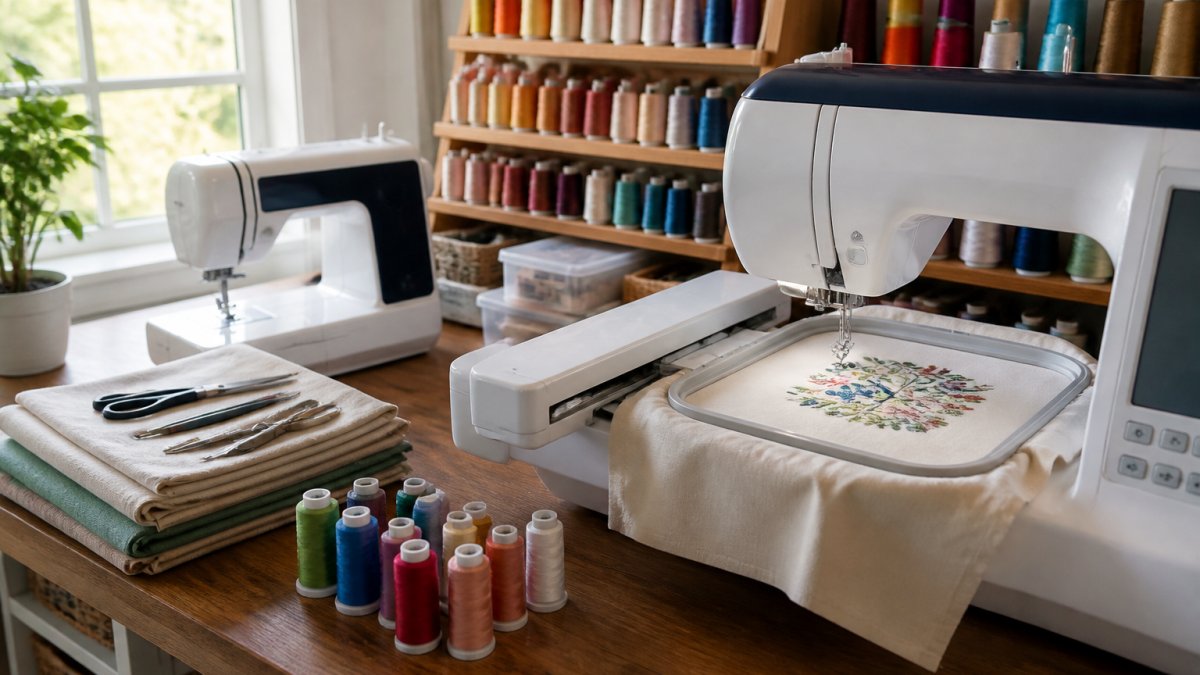
A single-needle machine handles one thread color at a time, so multi-color designs require manual rethreading. These suit hobbyists, gift makers, and small Etsy sellers doing low-volume personalized work.
A multi-needle machine holds several cones and switches colors automatically. If you're chasing corporate contracts or team uniform orders, this is the machine that keeps productivity up. The trade-off is price and a steeper learning curve.

Start where your order volume actually is.
Consumables decide your stitch quality more than most people expect. Rayon or polyester thread, the right needle size for your fabric, and the correct stabilizer prevent puckering and thread breaks.
For blanks, start with a small, tested range of apparel rather than a warehouse of options. A wash-away or tear-away stabilizer handles most jobs. Quality thread like Isacord holds color fast through repeated washes, which matters for corporate wear and repeat customers.
Embroidery digitizing software converts artwork into a stitch file your machine reads. This is the skill that separates a business from a hobby. You can outsource digitizing at first, but learning it gives you control over stitch count, hoop size limits, and how a design file actually runs.
Pick software that matches your machine's file formats. Then practice on scrap fabric before you touch a customer's garment. Learn how stitch count drives both stitch time and pricing, and how underlay stabilizes a design.
Register your embroidery business as a legal entity before you take payment. Most owners choose a sole proprietorship or LLC, filed with their state.
Get business registration right early: it affects your taxes, your ability to open a business bank account, and your liability protection.
SINGER® SE9180 Sewing & Embroidery Machine →
For federal requirements, the U.S. Small Business Administration's business guide walks through entity types and filings.
Knowing how to price embroidery work is where most new shops lose money. Price on stitch count, not gut feel. A design with more stitches takes more machine time, more thread, and more wear on your equipment.
Build your quote from five inputs: stitch count, number of items, setup or digitizing fee, blank cost if you supply the garment, and a spoilage allowance. Add your profit margin on top.
Stitch count is the backbone of every embroidery quote because it drives machine run time, thread consumption, and wear. As a planning anchor, a small left-chest logo typically runs in the low thousands of stitches, a full front design in the mid-to-high thousands, and a large back design can exceed ten thousand.
Machine time is the hidden cost. A multi-needle machine running a few thousand stitches per minute finishes a small logo quickly, but setup, hooping, and trimming add labor per item that stitch count alone does not capture.
Suppose a customer orders 24 polo shirts with a left-chest logo. The design runs a set stitch count, and you supply the blanks.
Your cost per shirt is roughly $21. At a 40% margin, you quote about $35 per shirt, plus the $35 setup fee on the first order. The 24-shirt order totals roughly $875. On the reorder, you drop the setup fee and quote about $35 per shirt again, which is easier for the customer to accept and keeps the account.
Charge a setup or digitizing fee on every new design. It covers the digitizer's time and signals that design work has value. Waive it on reorders, where the file already exists.
Build a spoilage allowance into every batch quote.
Rush orders should carry a premium, not a favor. A rush job compresses your schedule and pushes other work back, so quote a rush fee that reflects the disruption.
How to get embroidery customers comes down to showing finished work where your niche already looks. For corporate clients, that means samples, a simple one-page quote sheet, and direct outreach.
Local customers respond to visible proof: a booth at a school event, a sample polo on a business owner's desk, before-and-after photos of a design. Customer acquisition gets cheaper once repeat customers start reordering, so build the reorder ask into every delivery.
For paid and organic channel tactics, the U.S. Chamber of Commerce's small business marketing resources cover the basics well.
Production workflow decides whether you can scale. Batch similar jobs, keep a written order log, and set a realistic turnaround time you can actually hit. Order fulfillment means packing, labeling, and shipping without errors, plus a customer service process for the inevitable question.
Quality control is a habit, not a step. Check stitch density, trim threads, and inspect every item before it leaves your studio. A single puckered logo can cost you a corporate account.
At Stitch Pro Supply, our Learn First, Shop Second approach means we'd rather help you pick the right machine and supplies than sell you the biggest one. Explore our embroidery machines and stabilizers, and start with the setup that matches your actual order volume.
Most beginners spend between $2,000 and $8,000 to get going. The machine is the biggest line item: a capable sewing and embroidery combo like the SINGER SE9180 runs $799.99, while a HUSQVARNA VIKING DESIGNER QUARTZ 29 is $999.00. Add thread (Isacord spools are $5.29 each), stabilizer (a 12-sheet pack of Stick N Stitch is $15.99), blanks, hoops, and software. Budget separately for registration fees, insurance, and a small marketing reserve so you are not caught short in month one.
At minimum you need an embroidery-capable machine, hoops in the sizes you plan to stitch, a supply of thread in core colors, cut-away and wash-away stabilizer, needles matched to your fabric, and a way to digitize or purchase designs. A single-needle combo machine handles most startup work; a multi-needle machine becomes worth the cost once you are running repeat orders. Add good lighting, a dedicated table, and a heat press if you plan to offer apparel with printed names or numbers.
You do not need it on day one if you buy ready-made designs, but you will need it as soon as a customer asks for their own logo. Digitizing software lets you convert artwork into a stitch file, control stitch count, and adjust underlay for different fabrics. Many machines ship with a free tier or trial, and CREATIVATE connectivity on models like the SINGER SE9180 and HUSQVARNA VIKING QUARTZ 29 gives you design access without buying a separate suite immediately.
Start with your stitch count. A common formula is a base setup fee plus a per-1,000-stitch rate, then add the cost of the blank garment and any digitizing charge. For example, a 6,000-stitch left-chest logo on a $12 shirt might price at $8 for stitching, $12 for the blank, and a one-time $25 digitizing fee, for $45 on the first order and $20 on repeats. Always confirm your price covers thread, stabilizer, machine time, and your own labor.
It can be, but profit depends on volume and pricing discipline. The main levers are stitch count, how many items you run per hooping, and whether you charge properly for digitizing. A home-based setup with low overhead can reach a healthy margin on small-batch custom work, while a commercial space needs steady order flow to cover rent and equipment. Track your break-even point in units per month so you know exactly how many jobs you need before you are making money.
Start local. Small businesses, schools, teams, churches, and clubs all order embroidered apparel in batches. Bring samples to the businesses you already visit, set up an online store for repeat orders, and post finished work on social media with clear pricing. Ask every customer for a referral and offer a small discount on their next order. Repeat customers and word of mouth usually outperform paid ads for a new embroidery shop.
The hardest part of starting an embroidery business isn't the stitching, it's matching your equipment and pricing to real demand. Stitch Pro Supply supports that decision with education-first guidance, carefully selected machines and supplies, and fast U.S. shipping. Get started with Stitch Pro Supply and build a studio that grows with your orders.


