Your Cart (0)
Your cart is empty
Tax included and shipping calculated at checkout
Drawer menu
Tax included and shipping calculated at checkout

Last Updated: October 30, 2026
Quick Summary
The best batting for potholders is 100% cotton batting paired with a heat-reflective insulated layer, because cotton resists scorching without melting while the reflective film blocks radiant heat from the oven rack. Use two layers of cotton plus one layer of insulated batting with the film facing the heat.
The best batting for potholders is 100% cotton batting paired with a heat-reflective layer: cotton handles contact heat without melting, and the reflective layer blocks radiant heat from the oven rack. The wrong batting can scorch, melt, or fail at exactly the moment someone grabs a hot pan.
Below, we'll show how each batting type behaves under heat, how to layer it, and which one fits your project.
Four batting types show up in potholder projects: 100% cotton batting, insulated batting with a reflective film, polyester fleece, and light fusible polyester batting. Each one behaves differently when heat hits it.
If you're comparing how these are constructed, our guide on needle punched vs resin bonded batting explains how the fibers hold together and why that affects durability in a hot kitchen.
| Batting Type | Heat Behavior | Best Use | Watch Out For |
|---|---|---|---|
| 100% cotton batting | Resists scorching, no melt | Potholders, mitts, cozies | Needs layering for real protection |
| Insulated batting | Reflects radiant heat | Potholders, oven mitts | Film side must face the heat |
| Polyester fleece | Soft loft, lower melt point | Crafts, placemats | Not for direct oven contact |
| Light fusible polyester | Adds body and structure | Bags, wall hangings | Not a heat barrier |
Cotton batting is a common starting point for potholders because cotton does not melt.
The trade-off is thickness. A single layer of low-loft cotton won't protect your hand from a 450°F sheet pan for long.
Our Plate Cozy Pre-Cut Batting 8ct and Large Bowl Cozy Pre-Cut Batting 8ct are both 100% cotton, needle-punched, low loft, and made in the USA.
For anything going into a microwave, the fiber content has to be all cotton, top to bottom.
Insulated batting with a reflective film reflects radiant heat away from your hand, which is why it is used in many oven mitt patterns.
What it doesn't do is work alone.
Orientation matters. The shiny film side should face the heat source.
Best for: oven mitts and potholders that see regular oven use. Skip if: you're making a decorative trivet that never touches direct heat.
Layer counts change by project. Below are general layer recipes.
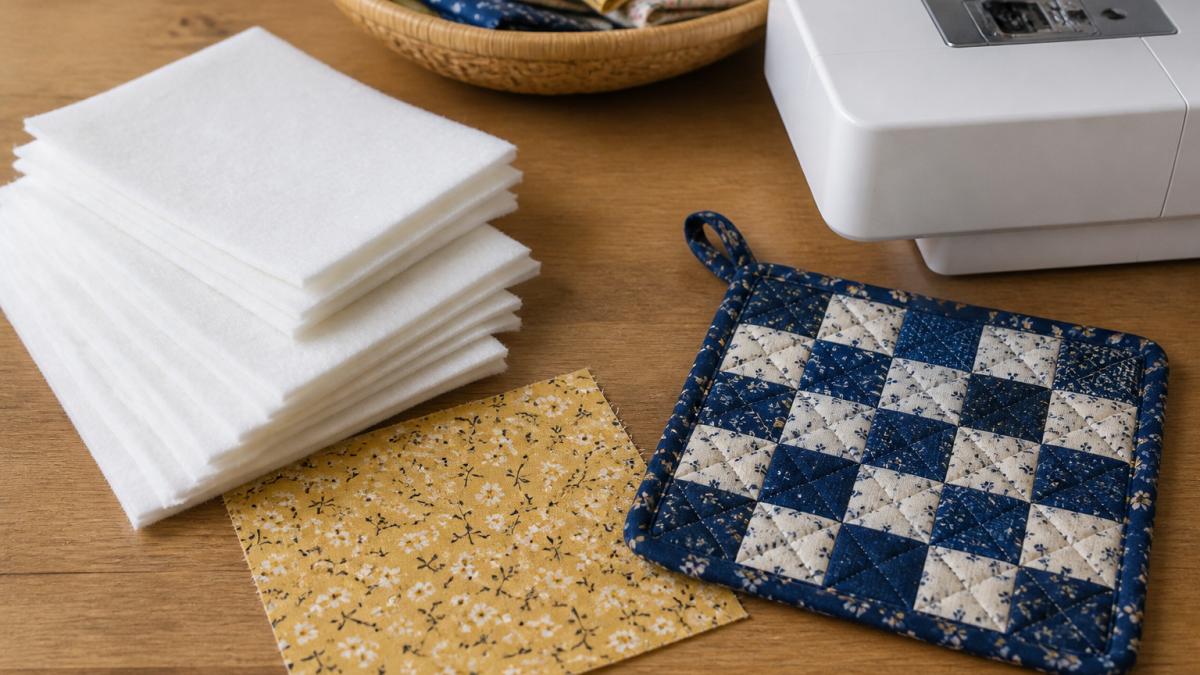
Use two layers of cotton batting plus one layer of insulated batting, film facing toward the heat. Quilt closely so nothing shifts. For mitts, add a third cotton layer at the palm.
Bowl cozies and plate cozies are a different animal: they go in the microwave, so every layer must be cotton. Use two layers of 100% cotton batting and nothing else. Our plate cozy pre-cut batting and large bowl cozy pre-cut batting are already cut to size.


If you're deciding how thick to go before you commit, our breakdown of low loft vs high loft batting explains how loft changes both insulation and bulk.
Polyester batting belongs in projects that never see an oven: placemats, table runners, wall hangings, baby bibs, and purses.
It fails at heat.
Our Warm Company Fleece Polyester Double Sided Fusible Batting is a soft 100% polyester fleece that is machine washable and dryer safe.
The Single Sided Light Fusible Batting from Bosal Foam and Fiber is a 4.7 oz, 100% polyester batting that adds structure without firmness.
Plate Cozy Pre-Cut Batting 8ct →
Batting choice is only half of potholder safety; the other half is how you test the finished item and how you use it. Testing a potholder under sustained contact, steam, and heavy pan edges helps confirm its performance.
Use a controlled test that mimics real kitchen contact without risking a burn:
Record the results on a scrap of paper or in your project notes. A potholder that passes 5 seconds dry and steam but fails wet needs a different layer recipe, not more quilting.
No batting makes a potholder safe for unlimited contact. Weight matters too: a heavy pan concentrates force on a small area, compressing batting and reducing its insulating air space. For heavy pans, use a mitt with a third cotton layer at the palm rather than a flat potholder.
Microwave use is a separate safety category. Synthetic fibers and metallized films can arc, melt, or scorch in a microwave, so the only safe batting for bowl cozies and plate cozies is 100% cotton, and that means 100% cotton fabric and thread as well. A polyester thread or poly-cotton blend anywhere in the stack defeats the purpose.
For items made for personal use, common-sense testing is enough. The key point for makers is that batting alone does not guarantee protection: fiber content, layer order, quilting density, and moisture all change how a finished potholder performs.
Care is where a potholder's real-world performance is decided. A batting that insulates well on day one can lose loft, shift, or crack after a few wash cycles, often invisibly until you grab a hot pan. The guidance below is organized by batting type so you can match the wash routine to the material.
Cotton batting is machine washable, but expect some shrinkage and compression. Wash warm on a gentle cycle, tumble dry low, and remove while slightly damp to reshape. Quilting at 1-inch intervals keeps the batting from migrating; wider quilting lets cotton bunch and thin out, creating hot spots.
Wash on a gentle cycle in cool or warm water, air-dry or tumble low, and avoid wringing. Once the film cracks, the reflective layer loses effectiveness in that area, and the potholder can develop a hot spot that isn't obvious from the outside. Inspect the film side every few washes by turning the potholder inside out or feeling for stiffness and crunching.
It is not a heat barrier, so durability here is about appearance and loft rather than insulation. Tumble dry low; high heat can pill the surface over time.
Fusible batting holds structure through repeated washing only if it was fused properly in the first place. A weak fuse lets the batting separate from the fabric and bubble after a few cycles. Follow the manufacturer's fuse temperature and time, and wash in cool water to reduce stress on the adhesive. This batting adds body, not heat protection, so its durability matters for bags and wall hangings rather than potholders.
Polyester fleece potholders aren't recommended for oven use at all, so their lifespan is a craft question, not a safety one.
If shrinkage is a concern for a fitted project, our article on why quilt batting shrinks explains the causes and when shrinkage works in your favor.
Choosing batting comes down to one question: does this project touch heat? If yes, cotton and insulated batting. If no, polyester and fusible options give you more loft and structure for the money.
The right batting depends on the project. That's the idea behind Learn First. Shop Second.
Quick reference:
Yes, and it is the most forgiving option for beginners. A single layer of low-loft cotton batting is too thin for real heat protection, so use two to three layers, quilted closely together so the layers cannot shift. Pair it with 100% cotton fabric and cotton thread, because polyester thread can melt against a hot pan. Cotton scorches rather than melts, which gives you a warning before failure.
Insul-Bright adds a reflective layer that bounces radiant heat back toward the source, which helps on a hot baking sheet or a casserole dish. It is not a substitute for thickness, so most makers combine one layer of Insul-Bright with one or two layers of cotton batting. Place the shiny side facing the heat source. Check the manufacturer's guidance before using it near a microwave, since metalized films behave differently around microwaves.
Two to three layers covers most kitchen use. Two layers of low-loft cotton batting handles everyday pans and baking dishes. Three layers, or two cotton plus one Insul-Bright, suits oven mitts and casserole covers that see longer contact with hot surfaces. More layers add bulk that makes turning and topstitching harder, so test a scrap sandwich before committing to a full set.
Treat that as a no unless the batting packaging explicitly says otherwise. Insul-Bright contains a metalized film, and metal in a microwave is a fire risk. For bowl cozies and plate cozies that go into the microwave, use 100% cotton batting with 100% cotton fabric and 100% cotton thread. Stitch Pro Supply's pre-cut plate and bowl cozy batting is 100% cotton for exactly this reason.
Polyester works for projects that never touch a hot surface: placemats, table runners, wall hangings, baby bibs, and purses. It adds loft and holds shape well, and fusible versions save pinning time. Keep it away from oven mitts, potholders, and anything that goes into a microwave, because polyester fibers melt at temperatures a hot pan can reach.
The hardest part of a potholder project isn't the sewing. It's picking the right batting before you cut into your fabric. At Stitch Pro Supply, we stock pre-cut cotton batting sized for plate and bowl cozies, plus the fusible and fleece options for everything else, so you can match the batting to the project instead of guessing. Get started with Stitch Pro Supply and build a potholder that actually protects your hands.


