Your Cart (0)
Your cart is empty
Tax included and shipping calculated at checkout
Drawer menu
Tax included and shipping calculated at checkout

Last Updated: October 12, 2026
When you buy a professional embroidery machine online, the machine itself is only half the decision. The other half is the support, warranty, and setup help that arrives with it. At Stitch Pro Supply, we prioritize education before every purchase, empowering makers to choose the right tools with confidence and clarity.
Here's the good news: a professional embroidery machine is simply a machine built for repeated, reliable stitching rather than occasional hobby use. That definition matters because it changes what you should look for.
Most buyers start by comparing stitch counts. That's the wrong first question.
The right first question is how many needles you need. Everything else, price, speed, design capacity, follows from that single answer.
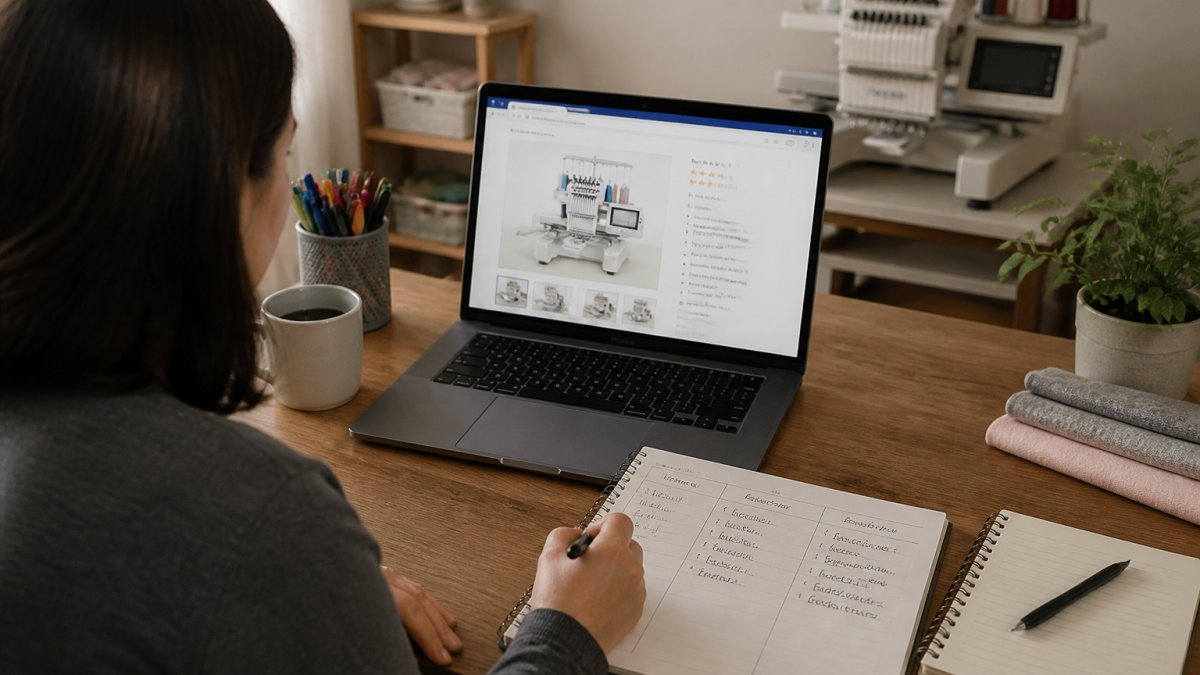
A single-needle machine uses one needle and one thread cone at a time. You swap colors manually. A multi-needle machine holds several cones at once and changes colors automatically.
For most home studios and small Etsy shops, a single-needle machine is the practical choice. It costs less, takes up less space, and handles the personalization work that drives most small-business orders.
Multi-needle machines make sense when you're running the same design across dozens of items. The automatic color changes save real time on repeat production.
Professional embroidery machine price varies widely by needle count, embroidery area, and screen size. Two machines with similar stitch counts can sit hundreds of dollars apart because one includes a larger touch screen or built-in design library.
At Stitch Pro Supply, our current sewing and embroidery machines run from $799.99 to $1,399.00. The SINGER® SE9180 sits at $799.99 with a 7" touch screen, over 150 built-in embroidery designs, and more than 250 stitches. The HUSQVARNA® VIKING® DESIGNER QUARTZ™ 29 is $1,399.00 with 180 built-in designs, 10 embroidery fonts, and two included hoops.

That gap isn't arbitrary. The HUSQVARNA® VIKING® DESIGNER QUARTZ™ 29 offers a larger design library, more fonts, and CREATIVATE™ (formerly mySewnet™) connectivity that lets you move designs between your machine, laptop, and phone.
The purchase price is the beginning, not the total. Budget for these:
The best commercial embroidery machine for a growing shop is the one whose specs match your order profile, not the one with the longest feature list. Production capacity is a math problem: needles, embroidery field, stitch speed, and thread trims together determine how many finished pieces you can ship per day.
Start with throughput. A machine rated at 1,000 stitches per minute running a 6,000-stitch left-chest logo completes roughly one piece every six minutes of stitch time, before hooping, trimming, and re-hooping. Add realistic handling time and a single-head machine typically produces a few dozen small logos in an eight-hour day. A multi-needle head with automatic color change removes the manual thread swaps that eat that time on repeat runs.
Match the machine to the work you actually sell:
Specs only help when they're lined up the same way. Use a table like this to compare any two professional models before you buy:
| Spec | Why It Matters | What to Record |
|---|---|---|
| Needle count | Sets color-change time | 1 vs. 6 vs. 10+ |
| Embroidery field | Limits largest design | Max hoop size in inches |
| Stitch speed | Sets hourly output | Stitches per minute |
| Automatic thread trim | Cuts manual stops | Included or optional |
| Built-in designs | Reduces design purchases | Count and file formats |
| Connectivity | Speeds design transfer | USB, wireless, or cloud |
| Included hoops | Affects what you can stitch day one | Sizes and count |
| Warranty | Protects your investment | Length and coverage |
Fill this in for every model on your shortlist. Two machines with similar stitch counts can differ sharply once field size, included hoops, and warranty are standardized side by side.
Match the machine to the work you actually sell. If your typical order is a handful of personalized items, a single-needle machine with a large field and fast stitch speed can be a great fit. If you're quoting dozens of identical pieces with tight turnaround, the automatic color changes on a multi-needle machine can help you promise a delivery date and keep it.
Before you commit, estimate your peak weekly piece count, the average stitch count per design, and your realistic handling time per item. If the machine's daily output can't clear your peak week with margin, it's the wrong machine regardless of price.
SINGER® SE9180 Sewing & Embroidery Machine →
U.S. Small Business Administration guidance on choosing equipment for a small business
A used embroidery machine can save money up front, but the savings depend entirely on what you give up. When you buy used embroidery machine listings online, you often lose the manufacturer warranty, the setup support, and any return option.
New machines come with a warranty, technical support, and a return window. Refurbished and certified used machines sit in between, usually with a shorter warranty and a lower price.
The deciding factor is your tolerance for downtime. A hobbyist can wait a week for a part. A shop with orders due can't.
If you buy used, ask these before paying:
An embroidery machine retailer return policy determines what happens when the machine isn't right. Read it before you order, not after.
Most policies hinge on three things: the return window, the condition requirement, and who pays return shipping. A machine that's been threaded and used may not qualify as returnable in original condition, even within the window.
Ask these questions directly:
A policy that looks generous on the surface can fall apart on the shipping question. Embroidery machines are heavy, and return freight isn't cheap.
Before you check out, confirm the support structure around the machine. Warranty length, technical support access, and setup help matter as much as the specs.
Use this checklist:
At Stitch Pro Supply, we built our process around the idea of learning first and shopping second. That's why every machine listing includes the specs that actually affect your work, and our expert support and practical education empower you to make better buying decisions.
Federal Trade Commission guidance on warranty rights for online purchases
Professional embroidery machine prices vary by needle count and features. Single-needle combination machines like the SINGER SE9180 start around $800, while multi-needle commercial models cost several thousand dollars. At Stitch Pro Supply, the HUSQVARNA VIKING DESIGNER QUARTZ 29 is $1,399.00. Factor in hoops, stabilizer, thread, and software when budgeting. Financing and monthly payment options can make higher-priced machines more manageable for business buyers.
Verify the embroidery area and hoop sizes, built-in design count, stitch speed, and file compatibility before you buy. Confirm the warranty length, who handles repairs, and whether the retailer offers technical support. Read the return policy carefully, including any restocking fees or return shipping costs. Check that the machine includes the accessories you need, such as hoops and presser feet, so you are not buying them separately.
New machines come with full warranty coverage and the latest features, which matters for business use. Certified used and open-box machines cost less but may have shorter warranties or limited return windows. If you buy used, check the stitch count, ask about service history, and confirm the machine was maintained by an authorized dealer. For production work, a new or certified refurbished machine with a solid warranty is usually the safer investment.
Look for a warranty that covers parts and labor for at least one year, with clear terms on what is excluded. The retailer should provide access to technical support, training resources, and authorized repair service. Ask whether the warranty transfers if you sell the machine later. A retailer that offers setup guidance and ongoing education reduces the risk of buying the wrong machine or struggling to use it.
Buying a professional embroidery machine online comes down to matching the machine to your real workload, not the biggest spec sheet. Stitch Pro Supply helps you make that call with clear specifications, honest guidance, and machines like the SINGER® SE9180 and HUSQVARNA® VIKING® DESIGNER QUARTZ™ 29 that cover both home studios and growing shops. Get started with Stitch Pro Supply and choose a machine you'll still be happy with a year from now.


