Your Cart (0)
Your cart is empty
Tax included and shipping calculated at checkout

Drawer menu
Tax included and shipping calculated at checkout

Last Updated: October 9, 2026
A sewing machine return policy is the set of rules a retailer uses to decide whether you can send a machine back, how long you have, and what you get in return. Most stores set their own terms, and those terms sit on top of your legal rights and the manufacturer's warranty.
Here's the part that trips people up: three separate systems are in play, and they don't overlap the way most shoppers assume.
Retailer policy covers the sale. It's the store's own rulebook: return window, condition requirements, receipts, and fees. The manufacturer warranty covers defects after the sale, usually through repair or replacement rather than a refund. Consumer rights sit underneath both, and they set a floor that no store policy can drop below.
A quick way to tell them apart:
Return windows vary widely by where you bought the machine, and the single most common mistake is assuming the clock starts the day you ordered. For shipped machines, it almost always starts on the delivery date, the day the carrier marks the package delivered, not the day you opened the box.
Here's how the major categories compare. Treat these as typical ranges, not guarantees, the written policy on your receipt or order confirmation always controls.
| Retailer Type | Typical Return Window | Clock Starts | Opened-Box Returns | Restocking Fee |
|---|---|---|---|---|
| Big-box store (mass merchant) | 15-30 days | Purchase or delivery date | Usually allowed within window | Sometimes on opened electronics |
| Online marketplace | 30 days | Delivery date | Allowed, but seller sets terms | Varies by third-party seller |
| Sewing specialty shop | 30-60 days | Purchase date | Often flexible, exchange-friendly | Rarely, if unopened |
| Direct from manufacturer | 30 days | Delivery date | Case-by-case | Warranty handles defects separately |
| Warehouse club | 30-90 days | Purchase date | Allowed | None on most items |
A few patterns worth knowing:
The window isn't always a fixed countdown. A few things can move it:
The window is only half the story. Stores also care about condition, proof of purchase, and whether you still have the box. We'll get to each.
Gather your paperwork before you contact anyone. The proof of purchase is the single item that decides most cases. Without it, you're relying on the store's goodwill or a card statement.
Have these ready:
If you bought online, log into your account and pull up the order. Most retailers accept a digital receipt, so a screenshot works fine. If you paid with a card, a statement line showing the purchase can sometimes stand in.
You can often still return a sewing machine without a receipt, but your options shrink.
What tends to work:
What usually doesn't work: walking in with just the machine and asking for cash back. Stores have no way to confirm you bought it there, and their terms typically require proof.
For gifts, this matters. If someone bought you a machine, ask them for the gift receipt before you try to return it.
Returning a sewing machine without the original packaging is possible, but it depends on the store and the reason. If the machine is defective, most retailers are far more flexible.
Here's how to improve your odds:
The accessories matter more than the box. A machine missing its presser feet, bobbin case, or power cord is far harder to return than one missing a bit of cardboard.
Explore Our Collections Today →
A defective machine gives you more paths than a simple change of mind. You can usually choose between repair, replacement, or refund, but which one you get depends on how long you've had it and the store's terms.
Use this decision path:
Document everything. Keep your receipt, note the dates, and save any emails. A paper trail turns "we can't help you" into a case someone has to answer.
Escalate when the store won't honor its own written policy or your legal rights. If that fails, a chargeback through your card issuer is often the fastest route. FTC guidance on resolving consumer problems explains how to file a complaint with the right agency.
For defective products, the U.S. Consumer Product Safety Commission tracks safety issues and recalls. If your machine has a safety defect, that's a different and more serious path than a simple return.
Return shipping and restocking fees are where returns get expensive, and they're the details most shoppers discover too late. Sewing machines are heavy and oddly shaped, a full-size mechanical machine typically runs 15-25 pounds, and a computerized or embroidery model can exceed 30, so return shipping is rarely cheap.
The default depends on why you're returning:
A restocking fee is a percentage the retailer keeps to cover repackaging and resale. Common patterns:
Read the fee schedule before you open the box. If you're unsure whether you'll keep the machine, keep the packaging intact until you've decided.
Refunds aren't instant. A typical timeline:
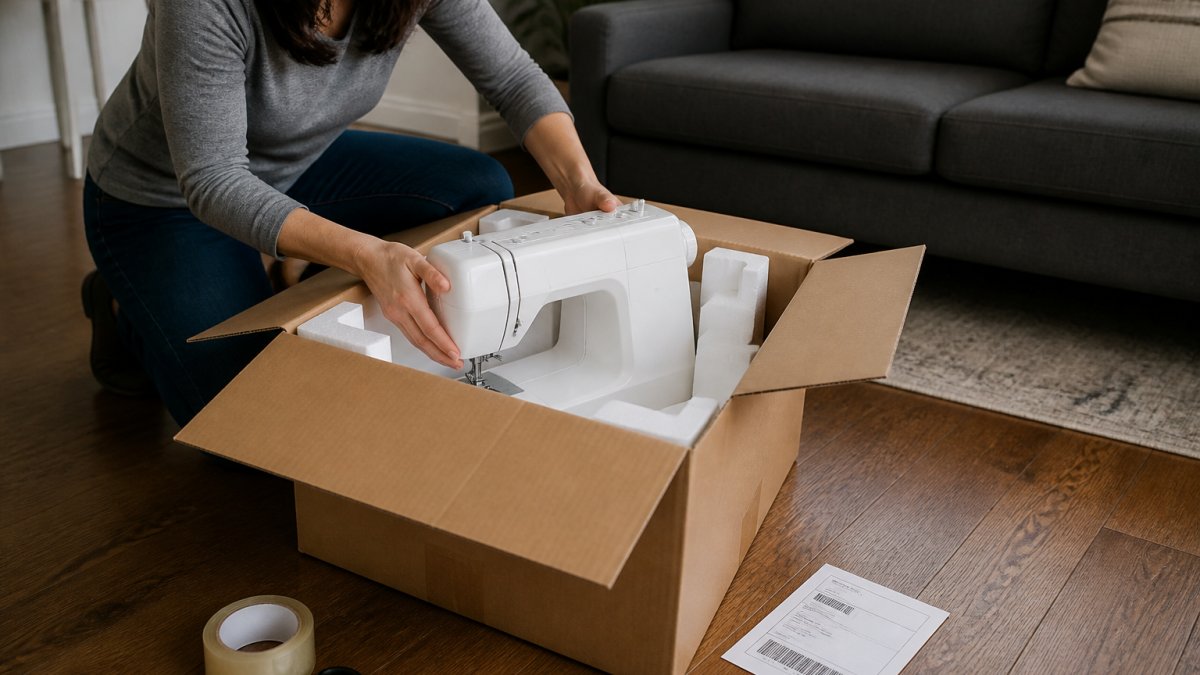
Pack it like it's going on a rough trip, because it is. A machine that arrives dented or with a cracked housing can be rejected or downgraded to store credit.
A complete packing checklist:
USPS guidance on shipping high-value items covers how to insure a package so you're covered if it's lost or damaged in transit. If the machine is worth more than a few hundred dollars, the extra insurance is cheap relative to the cost of a denied claim.
Most retailers accept opened sewing machines within their stated return window, but the machine usually needs to be in resellable condition with all accessories and manuals included. Some retailers charge a restocking fee of 10-15% for opened electronics. A few sellers treat opened machines as final sale, so check the policy before you break the seal. If the machine is defective, opened-box returns are almost always accepted regardless of restocking rules.
Most large retailers offer a 15 to 90 day return window, with 30 days being the most common. Specialty sewing retailers often allow 30 days for unopened machines and 14 to 30 days for opened ones. Some warehouse clubs extend returns to 90 days. Your sewing machine return window starts on the delivery date for online orders, not the order date, so check your tracking confirmation for the exact deadline.
It depends on the retailer. Many stores accept returns without the original box if the machine and all accessories are present, but they may charge a restocking fee or issue store credit instead of a full refund. To return a sewing machine without original packaging, use a sturdy box with at least two inches of padding on all sides. Keep the foot pedal, power cord, presser feet, and manual together, since missing accessories often triggers a fee or rejection.
Contact the seller immediately and document everything: photograph the damage, save the packaging, and note the order number. Most retailers offer a direct replacement or full refund for defective machines within the return window, and they cover return shipping. If the window has passed, the manufacturer warranty usually covers repair or replacement for one to five years depending on the brand. Keep your receipt, since warranty claims require proof of purchase.
Returns are stressful, and a machine you're unsure about makes it worse. At Stitch Pro Supply, we'd rather help you pick the right machine the first time. Our Learn First. Shop Second. philosophy means expert support and practical education before you buy, so you spend less time second-guessing and more time creating. Browse our curated machines and supplies, and let our team help you choose with confidence.


