Your Cart (0)
Your cart is empty
Tax included and shipping calculated at checkout

Drawer menu
Tax included and shipping calculated at checkout

Last Updated: October 12, 2026
Walk into any quilting forum and you'll find the same argument: why buy premium quilting machines when a basic model stitches fabric just fine? A premium quilting machine is built for quilters first, with the throat space, stitch regulation, and tension control that large quilts demand.
That's the real cost of buying cheap: you pay twice.
Below, we'll break down what separates machine tiers, when a longarm earns its footprint, and how to run the numbers.
Three specifications decide whether a machine fights you or works with you: throat space, tension control, and stitch regulation. Everything else is a bonus.
Throat space is the working distance from the needle to the tower, and it determines how much quilt fits under the arm at once. The SINGER® Patchwork 7285Q offers 140mm, or 5.5 inches, which handles most home projects comfortably. Premium longarm and midarm machines push that number much higher: more throat space means fewer fabric rolls, less wrestling, and straighter stitches on a queen-size quilt.

Stitch regulation keeps stitch length consistent as you change speed, which matters most during free-motion work. Dual feed moves fabric from above and below at the same rate, so layers stay aligned without pinning every inch. On a basic machine, you manage tension by feel and re-adjust constantly; on a premium machine, the system holds tension across speed changes, fabric weights, and thread types.
A longarm quilting machine is worth it when your quilting volume, project size, or business income justifies the space and cost. For an Etsy seller or studio owner quilting weekly, the time savings can change the math.
U.S. Small Business Administration guidance on evaluating equipment purchases offers a useful framework: treat any major equipment decision as a capacity question first.
Most buying guides skip the definition that matters most: what does premium buy you that a lower-cost model does not? Premium is not a brand tier, it is a set of capabilities that change how a quilt gets made.
| Capability | Entry-Level / Domestic | Premium Longarm or Midarm |
|---|---|---|
| Throat space | Roughly 5-9 inches on many home machines | Commonly 15-26 inches on longarms |
| Stitch regulation | Rare or basic | Standard, often with multiple modes |
| Tension system | Manual, adjusted by feel | Automatic or electronic, holds across speed changes |
| Frame and carriage | None, quilt is pushed through | Full frame with wheeled or track carriage |
| Speed | Limited by motor and feed | Higher sustained stitches per minute |
| Computerization | Basic stitch selection | Pattern library, edge warning, stitch-in-the-ditch |
| Service network | Varies widely | Dealer network with parts and technicians |
The practical result: on a queen-size quilt, an entry-level machine may require more fabric manipulation, and every re-position risks a shifted seam.
Marketing claims are easy; measurable differences are harder. A few benchmarks most quilters recognize:
None of these numbers are guarantees. They are the mechanisms by which premium machines save time, and why a quilter finishing one quilt a year rarely sees the return while one finishing monthly usually does.
Buying is not the only path. Before committing, weigh the alternatives:
The right answer depends on your volume, your workspace, and whether you want the machine to earn income or simply finish quilts.
Longarm machines use a frame and a stand-up or sit-down position, moving the machine head across a suspended quilt. Sit-down machines keep the quilt on a table while you guide it, much like a standard sewing machine with extra room. Stand-up longarms reduce back and shoulder strain on large projects and speed up the quilting pass.
A quick decision framework:
Match the machine to the quilter you will be in a year, not the one you are today.
The best quilting machine for home use is the one that fits your actual room, not the machine you'd buy in a showroom. Measure your table, doorway, and reach before you compare specs.
SINGER® Patchwork 7285Q Sewing & Quilting Machine →
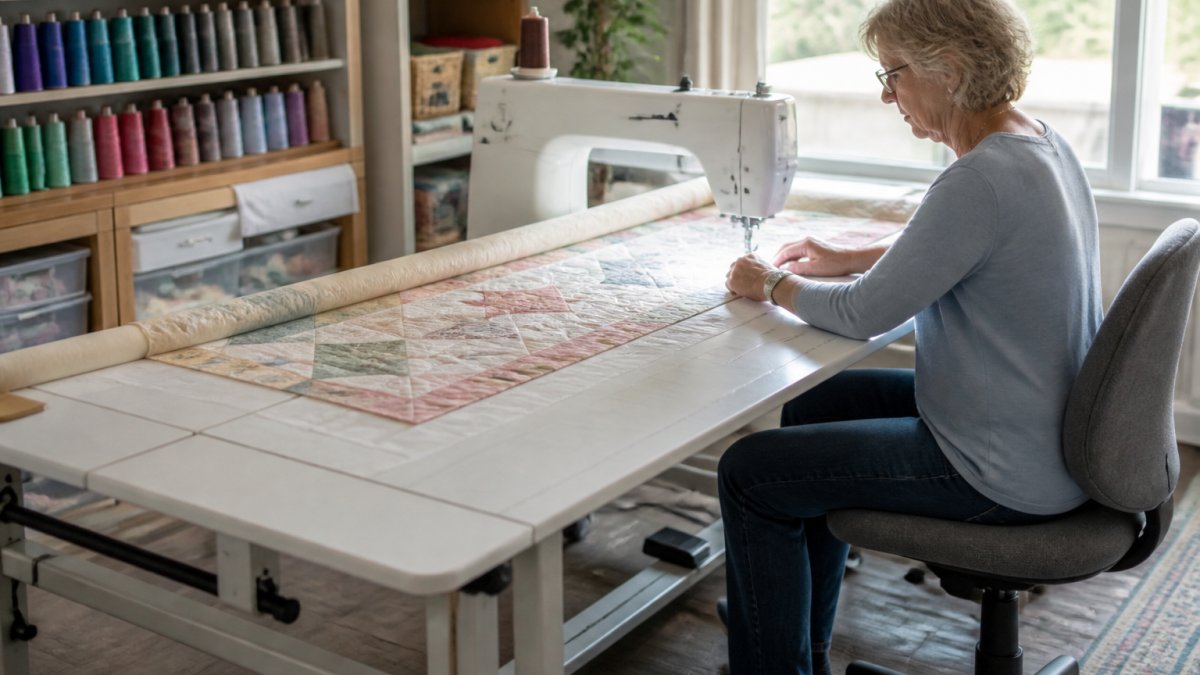
Machine footprint is the spec nobody mentions until delivery day. For most home quilters, a computerized machine with a removable extension table, like the SINGER® C7290Q, hits the sweet spot: enough quilting area for large quilts, and it breaks down when you need the table back.

The purchase price is the smallest number in the equation. Total cost of ownership adds the frame, accessories, software, maintenance, repairs, training, and financing, plus the value of your time. A premium machine that looks expensive on the sticker can be cheaper per finished quilt than a bargain machine that stalls on every large project.
| Cost Category | What It Includes | Entry-Level | Premium |
|---|---|---|---|
| Machine head | The sewing unit itself | Lower | Higher |
| Frame or table | Required for longarm; optional extension table for sit-down | Often sold separately | Often bundled |
| Software | Quilting patterns, design, edge warning | Rare | Common, sometimes subscription |
| Accessories | Extra feet, bobbin cases, rulers, clamps | Minimal | Broader but pricier |
| Consumables | Thread, needles, bobbins, batting | Similar | Similar |
| Maintenance | Cleaning, oiling, timing, tension calibration | Owner-doable | Dealer-recommended |
| Repairs | Parts and labor when something fails | Parts may be scarce | Dealer network |
| Training | Classes, tutorials, dealer onboarding | Self-taught | Often included |
| Financing | Interest if purchased on credit | Varies | Varies |
The two categories buyers most often forget are frame/table and software. A longarm without a frame is not a longarm; a computerized machine without pattern software is a very fast straight-stitcher.
Payback period is simple arithmetic: total cost divided by the value the machine produces per period. The hard part is deciding what counts as value.
Business quilters may find that a machine running near capacity contributes to their bottom line, while hobbyists rarely measure payback at all.
Financing terms change the effective price. A lower monthly payment over a longer term can cost more in total interest than a shorter term at a higher rate. Read the terms, not the payment.
Warranty coverage is a cost factor too. A machine with a strong warranty and a local service network keeps repair costs predictable; a machine with no parts channel turns a single failure into a full replacement. Federal Trade Commission guidance on warranty rights explains what warranties must disclose, so you know what you are actually promised before you sign.
If the machine will run weekly and produce income, run the payback math and buy the capacity you need. If it will run a few times a year for personal projects, buy for the projects you actually finish, and consider renting longarm time for the occasional queen-size quilt instead of owning the frame.
Yes, with one condition: buy for the quilter you'll be in a year, not the quilter you are today. Beginners often assume premium means complicated. The opposite is usually true.
Modern premium machines can simplify complex tasks. The SINGER® C5980Q Patchwork Plus, for example, includes an extension table, drop feed, programmable needle position, and speed control, features that can make learning easier.
Warranty coverage and parts availability decide what year three looks like. A machine with a strong warranty and a service network stays repairable; a bargain machine with no parts channel becomes a paperweight.
Ask three questions before buying: What does the warranty cover, and for how long? Premium brands often provide comprehensive answers to these questions, which is part of what the higher price buys. Federal Trade Commission guidance on warranty rights explains what warranties must disclose, so you know what you're actually promised.
The honest answer to why buy premium quilting machines is that premium buys capacity: more throat space, better tension control, faster workflow, and a machine that stays serviceable. If your volume, project size, or income justifies that capacity, the math works.
That's the whole philosophy behind Stitch Pro Supply: learn first, shop second. We carry machines like the SINGER® Patchwork 7285Q and the C7290Q with extension tables, and we're happy to talk through throat space, footprint, and stitch features before you spend a dollar.
It depends on how much you quilt and what you quilt. A premium quilting machine costs more upfront, but the larger throat space, stitch regulation, and tension control reduce rework on large quilts and cut finishing time. If you quilt several bed-sized projects a year, sell finished work, or take custom orders, the time savings and consistent stitch quality often justify the price within a few years. For occasional small projects, a mid-range machine like the SINGER Patchwork 7285Q at $239.99 covers the basics well.
Start with throat space, since it determines the largest quilt you can maneuver without wrestling the fabric. Then check stitch regulation, tension control, and dual feed for consistent stitches across seams. Speed control matters for free-motion work, and programmable needle up/down saves repositioning time. The SINGER C5980Q Patchwork Plus at $339.99 includes an extension table, drop feed, and speed control, which are the core features beginners and home quilters use most.
Yes. Beginners who plan to quilt regularly often grow into a premium machine faster than expected, while those still testing the hobby may prefer to start simpler. The SINGER C7290Q at $379.99 includes 12 presser feet and an extension table, so you can learn on a machine that still supports larger projects as your skills develop.
A longarm quilting machine has a much longer throat space, often 18 to 30 inches, and typically runs on a frame where you move the machine rather than the quilt. That setup makes finishing large quilts faster and reduces strain on your shoulders and back. A regular sewing machine, including quilting-focused models like the SINGER Patchwork 7285Q with its 5.5-inch throat space, handles piecing and smaller quilts well but requires more fabric maneuvering on bed-sized projects.


