Your Cart (0)
Your cart is empty
Tax included and shipping calculated at checkout

Drawer menu
Tax included and shipping calculated at checkout

Last Updated: October 1, 2026
Throat space is the open distance between the needle of a sewing machine and the right side of the machine's body, the working area your quilt passes through. This guide from Stitch Pro Supply breaks down what that number means in practice, because it decides whether a quilt feels easy or exhausting.
The bigger the gap, the more quilt you fit without wrestling it; the smaller the gap, the more you fold, roll, and reposition.
How to Measure Your Machine's Throat Space
Measure throat space by lowering the needle to the bed and running a tape measure straight across from the needle to the inside edge of the machine's right arm. That horizontal distance is throat space, sometimes listed as throat depth. The vertical clearance from the bed to the underside of the arm is throat height, which matters when you stack bulky layers.
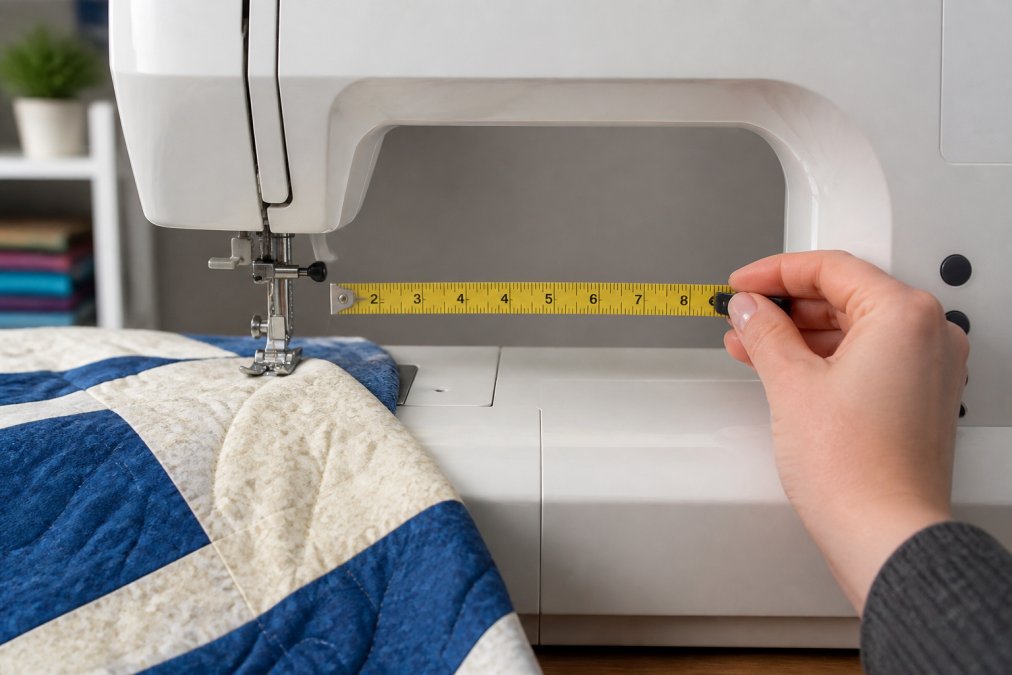
Before you trust a spec sheet:
Throat space controls how much fabric bulk you can push through at once, shaping both stitch quality and comfort. On a narrow throat, a queen-size quilt bunches into the gap, dragging against the bed and pulling your stitches.
The effects show up in three places:
Throat space also sets the ceiling on your project capacity, so it is the first number to check if you plan to grow past lap quilts.
Throat space and harp space describe the same measurement: the open area under the arm of the machine. Harp space is the older term in quilting circles, and throat space, throat depth, and harp space all point to that needle-to-pillar distance.
Bed size, by contrast, is the full length and width of the machine's work surface, including any extension table.
| Term | What It Measures | Why It Matters |
|---|---|---|
| Throat space | Needle to right arm, horizontal | How much quilt fits in the gap |
| Harp space | Same measurement, older term | Interchangeable with throat space |
| Throat height | Bed to underside of arm | Clearance for stacked bulky layers |
| Bed size | Total flat work surface | Support for the quilt's weight |
Typical throat dimensions by machine class
| Machine class | Typical throat depth | Typical throat height | Realistic quilt capacity |
|---|---|---|---|
| Standard domestic | 5 to 7 inches | 4 to 6 inches | Crib to twin, worked in sections |
| Wide-throat domestic | 9 to 12 inches | 6 to 8 inches | Twin to queen, worked in sections |
| Midarm / shortarm | 12 to 18 inches | 8 to 10 inches | Queen to king on a frame |
| Longarm | 18 to 30+ inches | 10 to 14 inches | King and larger, full quilt in the throat |
What those numbers mean in quilt terms
Why the vertical number matters too
HUSQVARNA® VIKING® ONYX™ 15 Sewing →
You can quilt large quilts on a home machine by managing bulk instead of fighting it, and technique matters more than throat size. Quilters finish queen and king quilts on standard machines every day, they just work in sections.
Measure the throat the way it is actually used
Follow these steps:
Managing bulk comes down to rerolling and repositioning as you go, plus keeping the unworked portion off the bed. Fabric advancement is where most home quilters lose control.
A few habits that help:
The ergonomic cost of a small throat
A few adjustments reduce the load:
The best sewing machine for quilting depends on how large your projects run and how much space you have. For most home quilters moving up from a basic machine, a wide-throat domestic with quilting-specific features delivers the best balance of price, footprint, and capability.
| Machine | Price | Stitches | Best For |
|---|---|---|---|
| SINGER® Patchwork 7285Q | $279.99 | 203 | Beginners who want quilting features built in |
| SINGER® C5980Q Patchwork Plus | $339.99 | 417 | Quilters who need an extension table |
| HUSQVARNA® VIKING® ONYX™ 15 | $349.00 | 23 | Utility sewing with a large work space |
| SINGER® Quantum Stylist™ 9960 | $549.99 | 1,172 | Quilters who also want free-motion and lettering |
American Sewing Guild guidance on choosing a machine

For most home quilters, 7 to 10 inches of throat space handles crib and throw quilts comfortably. If you plan to quilt queen or king-sized projects on a domestic machine, look for 11 inches or more. Longarm machines start around 18 inches and go up to 30-plus inches, which is why they can handle full quilt rolls without constant repositioning.
Measure from the needle to the right pillar (the upright arm) at the machine bed, then measure from the bed to the bottom of the arm for throat height. Use a tape measure or ruler and record both numbers. Some makers list this as 'needle-to-pillar distance.' If you cannot find the spec in your manual, the physical measurement takes about 30 seconds.
Yes, but it takes patience and technique. A standard 7 to 9-inch throat forces you to roll and reroll the quilt frequently so only the working section stays in the throat. Quilters who do this successfully use a walking foot or free-motion foot, lower the machine's speed, and work in small sections. It is slower than using a longarm, but the finished result can be just as good.
A big one. Domestic sewing machines typically offer 5.5 to 11 inches of throat space, while longarm machines start around 18 inches and commonly reach 26 to 30 inches. That extra room means a longarm can quilt an entire king-sized quilt without rerolling. Midarm and shortarm machines sit between the two, usually around 12 to 17 inches.


