Your Cart (0)
Your cart is empty
Tax included and shipping calculated at checkout
Drawer menu
Tax included and shipping calculated at checkout

Last Updated: October 21, 2026
Choosing the best quilting machines for a home studio starts with one number: throat space. That gap between the needle and the machine tower decides whether you can wrestle a queen-size quilt sandwich through the machine or fight it every stitch of the way.
The table below is deliberately consistent. Where a manufacturer does not publish a spec, we say so rather than guess, and we flag which quilting feet and tables are included versus sold separately, because those add-ons change the real price.
| Machine | Price (USD) | Throat Space | Stitch Applications | Quilting Feet Included | Extension Table | Warranty (Machine) | Best For |
|---|---|---|---|---|---|---|---|
| Patchwork 7285Q | $239.99 | 5.5 in | 203 | Not listed | Limited manufacturer warranty; confirm terms at purchase | Budget beginners | |
| Patchwork Plus C5980Q | $339.99 | Not published | 417 | Walking foot and free-motion foot typically included; confirm bundle | Included | Limited manufacturer warranty; confirm terms at purchase | First-time quilters |
| C7290Q | $379.99 | Not published | 400+ | 12 presser feet including walking and free-motion | Included (removable) | Limited manufacturer warranty; confirm terms at purchase | Stitch variety and accessories |
| Quantum Stylist 9960 | $549.99 | Not published | 1,172 | Walking foot and free-motion foot typically included; confirm bundle | Included | Limited manufacturer warranty; confirm terms at purchase | Lettering and customization |
| SAPPHIRE 930 | $2,199.00 | Large sewing space (manufacturer description; exact inches not published) | 200+ | Not listed | Limited manufacturer warranty; confirm terms at purchase | Large projects | |
| Heavy Duty 6600C Sterling | $269.99 | 6.4 in | 215 | Walking foot and free-motion foot typically included; confirm bundle | Not listed | Limited manufacturer warranty; confirm terms at purchase | Free-motion work |
How to read this table. Throat space is the single best predictor of how large a quilt you can manage comfortably.

What this table does not capture. Footprint and weight vary enough that you should measure your table and storage space before ordering; a machine that fits your budget may not fit your studio. Noise and vibration also differ by model and are best judged in person or from owner reports. Finally, warranty terms vary by manufacturer and region, so confirm coverage and service options with the retailer before purchase.
We judged these quilting machines on home-studio reality, not showroom specs. Three filters did most of the work.
First, throat space. A 5.5-inch throat handles crib quilts and wall hangings comfortably. A 6.4-inch throat gives noticeably more room to roll bulky fabric. Anything described as a large sewing space suits full-size quilts without a long-arm.
Second, quilting-specific features. Drop feed, programmable needle up/down, speed control, and an extension table separate a real quilting machine from a general sewing machine.
Third, total cost of ownership. The machine price is only part of it. Presser feet, quilting tables, bobbins, and servicing add up. We weighted machines that ship with accessories already included, because that's money you don't spend later.
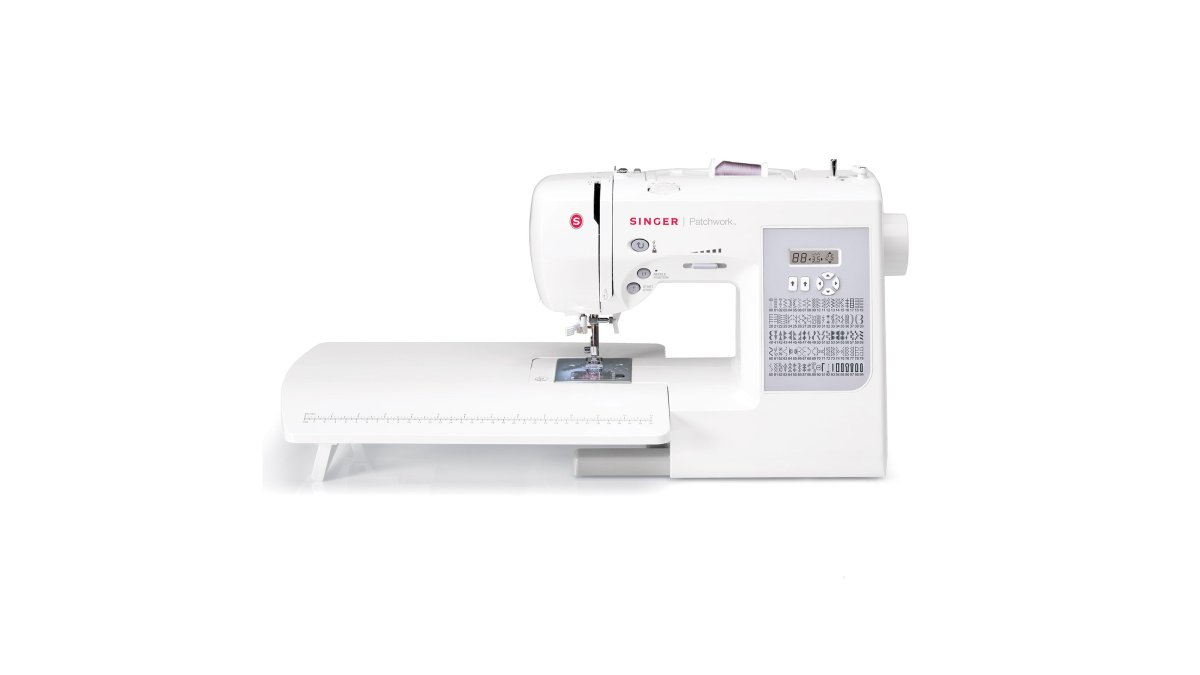
The Patchwork 7285Q is our pick for the tightest budgets, and it's the only machine in this list with a published throat measurement at the entry price. That 5.5-inch throat space handles small and medium quilts without complaint, and the 203 stitch applications cover piecing, decorative work, and everyday garment sewing.
What earns it a spot: programmable needle up/down. For free-motion quilting and applique, stopping with the needle down keeps your pivot point locked. Speed control lets you slow the machine for intricate free-motion designs and open it up for long seams.
Pros: Lowest price here, published throat spec, quilting-first design, six buttonhole styles. Cons: Smallest throat of the group, so king-size quilts will feel cramped.
SINGER Patchwork 7285Q Sewing & Quilting Machine
Beginners who want room to grow should look at the C5980Q Patchwork Plus. It's a computerized machine with 417 stitch applications and the features quilters actually use: extension table, drop feed, programmable needle position, and speed control. That combination is why we call it the best starter quilting sewing machine for most first-time buyers.

The extension table matters more than the stitch count. It supports the weight of a quilt sandwich so fabric feeds evenly instead of dragging off the edge of the bed. Drop feed lets you lower the feed dogs for free-motion foot work.
Pros: Extension table included, drop feed for free-motion, 417 stitches, easy learning curve. Cons: Throat space isn't published, so measure your largest project expectations against the 5.5-inch class before committing.
SINGER C5980Q Patchwork Plus Sewing & Quilting Machine
Twelve presser feet. That's the headline on the C7290Q, and it's the reason this machine wins on accessories per dollar. A walking foot and a free-motion foot alone can cost real money bought separately, and this machine ships with a full quilting toolkit plus a removable extension table.
Over 400 stitch applications and a built-in lettering font round out the package. If you want one machine that handles piecing, quilting, and personalized labels without buying add-ons, this is the value pick at $379.99.
Pros: 12 included presser feet, extension table, lettering font, 400+ stitches. Cons: More machine than a pure beginner needs, and the accessory bundle can overwhelm new users at first.
SINGER C7290Q Sewing & Quilting Machine
Custom quilts live or die on the details, and the Quantum Stylist 9960 delivers them. Five fonts and 1,172 stitch applications mean you can stitch names, dates, and monograms directly into a quilt label or border. Many stitches can be mirrored and elongated, which stretches your design options without extra software.
The needle up/down feature supports free-motion quilting and applique pivoting, and the top drop-in bobbin is easy to see so you don't run dry mid-seam. A thread trimmer cuts top and bottom threads with one button press.
SINGER® Patchwork 7285Q Sewing & Quilting Machine →
Pros: Five fonts, 1,172 stitches, mirror and elongate functions, thread trimmer, extension table. Cons: Highest price among the SINGER computerized models here, and the feature set takes time to learn.
SINGER Quantum Stylist 9960 Sewing Machine
For quilters pushing full-size projects through a home machine, the SAPPHIRE 930 is the large throat answer in this lineup. A large sewing space to the right of the needle gives you room to manage really large projects, and the automatic thread cutter works with the quilt still in the machine.

The SEWING ADVISOR feature sets stitch, length, width, and tension for you based on fabric and technique. The EXCLUSIVE SENSOR SYSTEM senses fabric thickness continuously for consistent fabric feed, which matters when a quilt sandwich changes thickness at every seam. Free-motion sewing works with any stitch.
Pros: Largest sewing space here, automatic tension and settings, sensor-guided fabric feed, start/stop without foot control. Cons: At $2,199.00 it costs more than every other machine on this list combined, so it only makes sense if quilting is a serious, ongoing practice.
HUSQVARNA VIKING SAPPHIRE 930 Sewing Machine
Free-motion quilters should start here. The Heavy Duty 6600C Sterling pairs a 6.4-inch throat, the largest published throat space in this group, with a powerful motor built for speed and thick layers. More throat room means less fabric bunching when you're moving a quilt sandwich under a free-motion foot.
Adjustable presser foot pressure helps on both ends: multiple layers of denim and canvas, or lightweight sheers. The stainless steel bedplate lets fabric glide, and the top drop-in bobbin is easy to monitor mid-project.
Pros: 6.4-inch throat, strong motor, adjustable presser foot pressure, stainless steel bedplate, $269.99. Cons: 215 stitch applications is modest next to the computerized models, and it has no extension table listed.
SINGER Heavy Duty 6600C Sterling Sewing Machine
Here's the honest summary: most home quilters don't need the most expensive machine, they need the right throat space, a supported fabric feed, and a realistic budget for everything the machine does not include.
Match the machine to your largest realistic project. If your quilting life is crib quilts, wall hangings, and table runners, a 5.5-inch throat is enough and the Patchwork 7285Q at $239.99 is the value pick.
Budget beyond the sticker price. The machine is the first line item, not the last.
Plan for maintenance and service. Routine care, cleaning lint from the bobbin area, oiling where the manual specifies, and replacing needles, keeps feed consistent and prevents skipped stitches on thick sandwiches.
Quick picks by priority:
Still unsure? Our team at Stitch Pro Supply walks you through throat space, project size, and accessory costs before you buy, because the right machine is the one you'll actually use.
Focus on throat space first, since it determines how much of a quilt you can fit under the needle. Look for a programmable needle up/down, adjustable speed control, and a drop feed for free-motion work. An extension table helps support the weight of a quilt sandwich. Stitch selection matters too: the SINGER C7290Q offers over 400 stitch applications, while the Quantum Stylist 9960 includes 1,172. Match features to your actual projects rather than buying the maximum.
For a home studio, 5.5 inches of throat space is workable for small to medium quilts, which is what the SINGER Patchwork 7285Q offers. If you plan to quilt larger projects, look for more room: the SINGER Heavy Duty 6600C Sterling provides 6.4 inches. More throat space means less fabric bunching and easier maneuvering of a quilt sandwich. Measure your typical quilt sizes before deciding, and remember that a long-arm machine is a separate category with much larger capacity.
Yes. Most quilting sewing machines for beginners are standard domestic machines with quilting-specific features. The SINGER C5980Q Patchwork Plus, for example, includes an extension table, drop feed, and programmable needle position, all of which support quilting. You do not need a long-arm machine to make quilts at home. A regular machine with the right presser feet, a walking foot for straight-line work, and a free-motion foot for designs will handle most home quilting projects.
A domestic sewing machine sits on a table and you feed fabric through it, which limits how much of a large quilt you can manage at once. A long-arm machine has a much longer throat and typically runs on a frame, so the quilt moves freely while the machine stays fixed. For a home studio, a standard machine with good throat space is usually the practical choice. The HUSQVARNA VIKING SAPPHIRE 930 offers a large sewing space for managing bigger projects without a frame.
Entry-level quilting machines start around $239.99, like the SINGER Patchwork 7285Q. Mid-range options with more stitches and accessories run from $339.99 to $549.99, including the C5980Q, C7290Q, and Quantum Stylist 9960. The HUSQVARNA VIKING SAPPHIRE 930 sits at the top at $2,199.00 for advanced features and a larger sewing space. Budget beyond the machine itself for presser feet, thread, bobbins, and an extension table if one is not included.


