Your Cart (0)
Your cart is empty
Tax included and shipping calculated at checkout
Drawer menu
Tax included and shipping calculated at checkout

Last Updated: September 22, 2026
Figuring out whether sewing right for you starts with one question: do you enjoy slow, hands-on problem solving? This guide from Stitch Pro Supply walks you through the honest signals, costs, and trade-offs.
A common mistake is assuming sewing is mostly about creativity. It's mostly troubleshooting.
Perfectionism cuts both ways. High standards push you to learn proper seam allowance and pressing habits, but the wrong kind makes beginners quit in week two.
You can test the waters for well under a hundred dollars, or spend several hundred on a full setup. The trick is knowing which money is a test and which is a commitment, and spending in that order.
Costs break into three buckets, and they don't arrive at the same time:
Here's the part nobody tells you: fabric quietly outruns everything else. A machine is a one-time purchase; fabric is recurring, and it scales with how often you sew, not how good you get.
If your goal is to save money on clothes, be honest about the math. Making a simple garment from scratch, pattern, fabric, thread, notions, and your time, often costs more than a comparable ready-to-wear piece, especially at fast-fashion prices. Custom sizing and one-of-a-kind fabric are real value, but not savings.
Once you're in, a full beginner setup, a new entry-level machine, the seven core tools, an iron, and starter fabric, typically lands in the low hundreds of dollars. That's a ceiling, not a floor. Stay under it by buying tools as projects demand them and using inexpensive cotton for practice instead of premium fabric you're afraid to cut.
You need less room than you think, but the right setup. A stable table, good light, and a comfortable chair matter more than square footage.
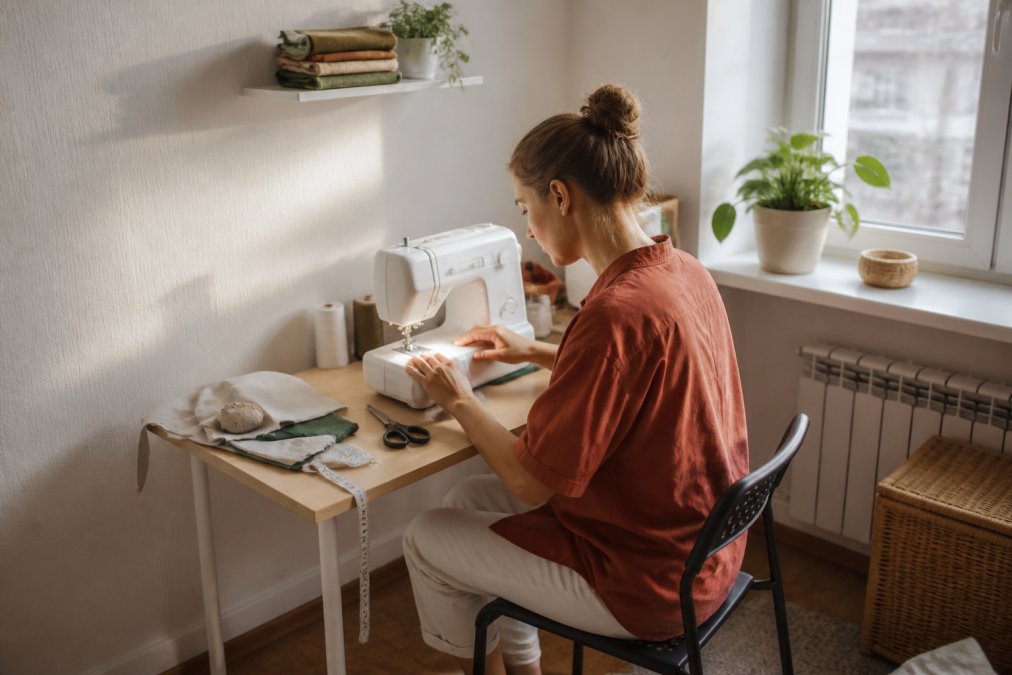
The best beginner setup is smaller than any store will tell you: about seven items, none of them fancy.
You'll know within three or four projects, usually a few weekends. Basics like straight seams and simple hems take a few hours of practice.
Here's a realistic timeline:
| Stage | Time Needed | What You'll Know |
|---|---|---|
| First straight seams | 1-2 hours | If the machine feels natural |
| First finished project | 1 weekend | If you enjoy the process |
| Third or fourth project | 3-4 weekends | If this is a real hobby |
| Comfortable with patterns | 2-3 months | If you want to keep going |
Sewing is gentle work, but it isn't weightless. Before you invest, ask whether its physical demands fit your body and daily energy, a question almost no beginner guide raises.
Sewing asks for three things physically, and they show up in different ways:
Run through these honestly:
If two or more of these are a real concern, start with hand sewing on a small project. A pincushion or a simple hem costs almost nothing, takes an evening, and tells you how your body responds.
A few habits keep sewing comfortable over the long run:
If you have a diagnosed condition affecting your hands, wrists, back, or vision, talk to your doctor or an occupational therapist. Ask whether sustained fine-motor work and static posture are safe for you, and whether modifications, a wrist brace, different chair height, shorter sessions, would help. Sewing is adaptable, but the adaptation should fit your situation, not a generic checklist.
If you've passed the personality check, the space test, and a few practice projects, it's time to buy. The right first machine is simple, reliable, and matched to what you'll actually make.
The SINGER M1000 Mending Machine is the lowest-risk way to find out if sewing fits you. It weighs 5.5 pounds, sets up fast, and runs 32 stitch applications, including straight stitch, zigzag, multi-step zigzag, and blindhem.

The SINGER M1500 is portable and lightweight, which makes it a great fit for sewing class or small spaces. Preset stitch length and width keep it simple for beginners, and 57 stitch applications cover fashions, quilts, crafts, and mending.
The SINGER Simple 3337 is the pick for someone who already knows they're in. It offers 108 stitch applications, one-step buttonholes, and a Top Drop-in Bobbin you can see through to monitor thread supply.
Some signs point to waiting, and that's a fine outcome. You're not failing a test. You're saving money and time.
Watch for these:
The basics are more approachable than most people expect. You can learn to thread a machine, wind a bobbin, and sew a straight stitch in an afternoon. The real challenge is muscle memory and reading patterns, which develops over weeks of practice. If you enjoy slow, hands-on problem-solving, the learning curve feels rewarding rather than frustrating. If you need fast results, start with simple projects like pillowcases or tote bags before tackling garment construction.
You can begin for under $200 total. A portable machine like the SINGER M1000 at $89.99 handles mending and simple repairs, while the M1500 at $119.99 adds 57 stitch applications for crafts and quilting. Budget another $40 to $60 for essential sewing tools: fabric shears, pins, a seam ripper, measuring tape, and thread. Fabric costs vary, but starting with thrifted sheets or clearance cotton keeps early practice cheap while you build sewing skills.
No. A machine needs roughly 36 by 24 inches of table space, plus room to the left for fabric to rest. Many beginners use a dining table or a folding desk and pack everything into a storage bin between sessions. If you plan to quilt or work with large yardage, you will want more room for cutting and layout, but for garments, mending, and small projects, a corner works fine.
People who enjoy incremental progress and fixing small problems tend to stick with sewing. You will rip seams, adjust tension, and re-cut fabric. That process rewards patience more than raw talent. If you like the idea of making something with your hands and do not mind redoing a step to get it right, sewing fits. If you get discouraged by imperfect first attempts, start with beginner-friendly projects and low-cost fabric to reduce the pressure.
Deciding whether to start is the hard part. Buying the right machine shouldn't be. Stitch Pro Supply pairs every beginner with practical education, carefully selected machines, and expert support, so you spend less time second-guessing and more time creating. Browse our beginner machines, ask us your questions, and start with the setup that matches where you actually are.


