Your Cart (0)
Your cart is empty
Tax included and shipping calculated at checkout

Drawer menu
Tax included and shipping calculated at checkout

Last Updated: September 30, 2026
Here's the short answer: an expensive sewing machine is worth it when your projects, production volume, or patience have outgrown a budget machine. At Stitch Pro Supply, we've watched too many makers buy twice because nobody explained what the extra money buys.
| Machine | Price | Best For | Standout Feature |
|---|---|---|---|
| SINGER® Quantum Stylist™ 9960 | $549.99 | Beginners and first upgrades | 1,172 stitch applications, speed control |
| SINGER® SE9180 | $799.99 | Sewing plus embroidery starters | 7" touch screen, 150+ embroidery designs |
| HUSQVARNA® VIKING® DESIGNER QUARTZ™ 29 | $1,399.00 | Etsy sellers doing both crafts | 180 designs, CREATIVATE™ connectivity |
| HUSQVARNA® VIKING® OPAL™ 690Q | $1,899.00 | Quilters and garment sewers | EXCLUSIVE SENSOR SYSTEM™, 8" sewing surface |
| HUSQVARNA® VIKING® SAPPHIRE™ 930 | $2,299.00 | Production and heirloom work | SEWING ADVISOR®, 200+ stitches, large throat space |
U.S. Small Business Administration guidance on equipment purchases

The gap isn't one feature. It's a stack of small engineering decisions that compound over hundreds of hours of use, corners you notice at month six, not day one.
A metal internal frame keeps the needle bar and feed dogs aligned under load; budget plastic housings flex at high speed, causing skipped stitches on denim and quilting layers. Motor torque matters for the same reason: a stronger motor holds speed steady through thick seams instead of stalling. Feed dog consistency makes stitch length repeatable across a project.
On premium models, cost shifts to electronics. The HUSQVARNA® VIKING® OPAL™ 690Q uses EXCLUSIVE SENSOR SYSTEM™ technology to sense fabric thickness and adjust feed automatically. The SAPPHIRE™ 930 adds SEWING ADVISOR®, which sets stitch, tension, and presser foot pressure for you. Stitch memory means you stop re-dialing settings when you switch fabrics.

A mechanical sewing machine uses dials and levers to control tension and stitch selection; a computerized sewing machine replaces those dials with a processor, sensors, and a screen. That difference explains most of the price gap between tiers.
Quilting is where an expensive sewing machine earns its keep fastest, because it stresses every part at once: multiple fabric layers, batting loft, and long continuous seams. Three specs decide whether a machine is comfortable or infuriating, throat space, feed dog consistency, and presser foot pressure control, and each has a number you can check before you buy.
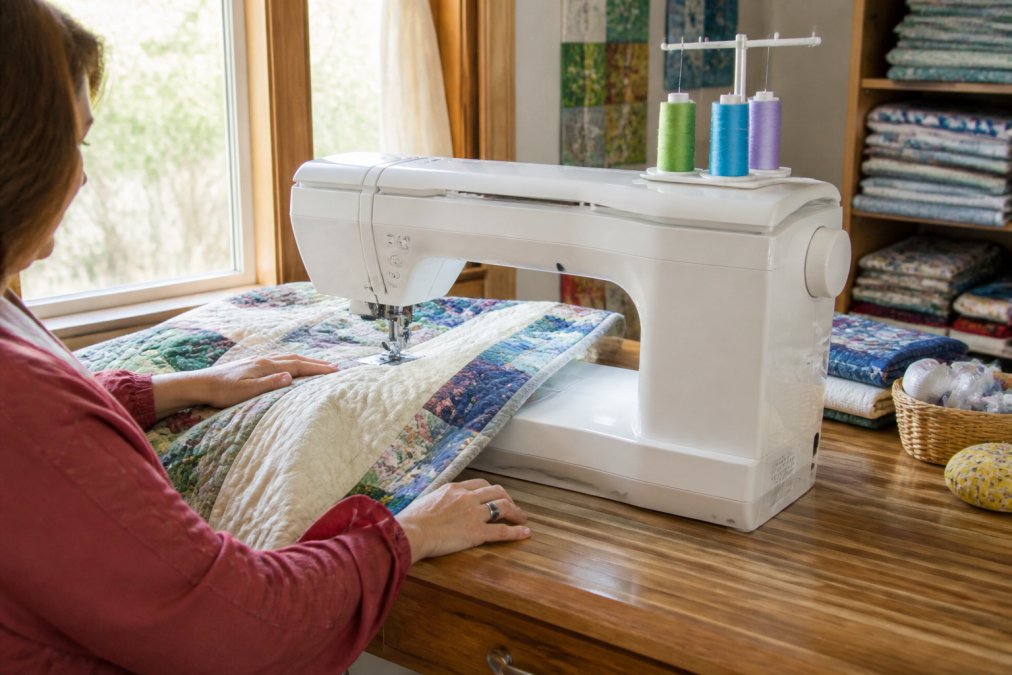
Throat space is the distance from the needle to the right side of the machine, measured at the bed. It's the most quoted number in quilting circles because it determines how much quilt you can bunch up to the right of the needle before the fabric fights back.
Feed dogs are the toothed bars under the needle plate that pull fabric through. On a single layer of cotton, almost any machine feeds evenly. On a quilt sandwich, top, batting, backing, they must move three layers of different weights at the same rate; if they can't, the bottom layer feeds faster and you get puckers.
Two accessories decide whether a machine is quilting-capable: a walking foot (also called an even-feed foot) and the ability to drop the feed dogs for free-motion quilting.
Total cost of ownership is the number nobody puts on the price tag. A $549.99 machine and a $2,299.00 machine are not $1,749 apart over ten years, they're apart by whatever you spend on service, parts, accessories, downtime, and resale loss, and that gap is smaller than the sticker price suggests.
SINGER® Quantum Stylist™ 9960 Sewing →
Most home machines need cleaning and oiling based on hours of use, not the calendar. A common pattern: a light clean (lint out of the bobbin case, new needle, drop of oil where the manual allows) every 8 to 10 hours of sewing, and a full professional service every 12 to 18 months of regular use.
Repairability favors machines with metal internals and available parts. Premium brands keep parts in distribution longer, and independent technicians are more likely to stock common components. Budget machines often go out of parts support within a few model cycles, turning a $40 repair into a replacement decision.
Depreciation is the quiet cost, and it's where the TCO math tilts. Premium machines from established brands hold value better because the name and feature set stay desirable used. Budget machines depreciate hard once a newer model ships, the used buyer has no reason to choose a three-year-old entry machine over a new one at a similar price.
You don't need a spreadsheet. Add four numbers for each machine:
| Cost Category | Budget Machine | Premium Machine |
|---|---|---|
| Purchase price | Lower upfront | Higher upfront |
| Annual service | Lower per visit | Slightly higher per visit |
| Parts availability | Limited long-term | Better long-term |
| Accessory cost | Often sold separately | Frequently included |
| Resale after 5 years | Steep drop | Holds better |
| Replacement risk | Higher | Lower |
| Realistic 10-year TCO | Closer than expected | Closer than expected |
Match the machine to the maker. The $549.99 SINGER® Quantum Stylist™ 9960 suits beginners and first upgrades: 1,172 stitch applications, a top drop-in bobbin, and speed control for long seams and detailed work.
An expensive sewing machine is not worth it if you sew a few times a year, only mend and hem, or haven't yet learned what you actually need. A premium machine rewards volume and complexity; without either, you're paying for capability you never touch.
It depends on what you sew. At Stitch Pro Supply, the SINGER Quantum Stylist 9960 is $549.99 and covers garment sewing and free-motion quilting with 1,172 stitch applications. Stepping up, the SINGER SE9180 at $799.99 adds embroidery with over 150 built-in designs. Serious hobbyists and small studios often land between $1,399 and $2,299, where automatic tension, larger sewing surfaces, and sensor-guided fabric feed reduce the time spent fixing problems instead of creating.
Yes, in specific, measurable ways. Machines like the HUSQVARNA VIKING OPAL 690Q use an electronic self-adjusting thread tension and an exclusive sensor system that continuously adjusts feed for any fabric thickness, so you stop rethreading and re-testing tension. The SAPPHIRE 930 adds a sewing advisor that sets stitch, width, and length for you. That automation matters most on thick seams, quilting layers, and long production runs, where a mechanical machine demands constant manual correction.
A well-maintained machine typically runs for many years, and computerized models are no exception as long as they are serviced and protected from dust and power surges. The deciding factors are internal frame construction, how easily parts can be replaced, and whether the brand still supports the model. Mechanical machines often survive longer with minimal care, while computerized machines reward consistent servicing. Buying from a seller that stocks parts and offers guidance makes a bigger difference than the sticker price.
Look for features that change your daily work: automatic thread cutting, a bobbin thread sensor that warns you before the bobbin runs out, a large area to the right of the needle for big projects, and automatic tension that adjusts per fabric. The HUSQVARNA VIKING DESIGNER QUARTZ 29 adds a 7-inch color touch screen, 180 embroidery designs, and cloud connectivity at $1,399. These are not cosmetic upgrades; each one removes a repeated interruption from your sewing session.
Vintage all-metal machines are reliable for straight stitching and simple seams, and they hold up well with basic oiling. They cannot match modern computerized models on stitch consistency at speed, automatic tension, embroidery, or quilting features like needle up/down and speed control. If your work involves free-motion quilting, decorative stitches, or embroidery, a current machine such as the SINGER Quantum Stylist 9960 at $549.99 gives you capabilities no vintage model offers, plus warranty coverage and available parts.


