Your Cart (0)
Your cart is empty
Tax included and shipping calculated at checkout
Drawer menu
Tax included and shipping calculated at checkout

Last Updated: October 12, 2026
Choosing the right needle for fabric is the most overlooked step in sewing.
A new sewer buys knit fabric, uses the needle that came in the machine, and watches it snag and run.
Your needle has one job: pass through fabric without damaging fibers. A sharp needle cuts cleanly through wovens; a ballpoint slides between knit fibers instead of piercing them.
A sewing machine needle chart by fabric takes the guesswork out of matching needle to material. Start with this table, then test on a scrap before sewing your project.
| Fabric Type | Best Needle Type | Common Size | Thread Weight to Pair |
|---|---|---|---|
| Lightweight woven (chiffon, voile, batiste) | Universal or Sharp | 60/8 or 70/10 | 60 wt or 100 wt fine thread |
| Medium woven (cotton, linen, quilting cotton) | Universal | 80/12 | 40 wt or 50 wt all-purpose |
| Heavyweight woven (denim, canvas, twill) | Sharp or Denim | 90/14 or 100/16 | 30 wt or 40 wt heavy-duty |
| Knit (jersey, ribbing, interlock) | Ballpoint | 80/12 or 90/14 | 40 wt or 50 wt polyester |
| Stretch (spandex, swimwear, activewear) | Stretch | 75/11 or 90/14 | 40 wt woolly nylon or polyester |
| Quilting layers (batting + top + backing) | Quilting | 80/12 or 90/14 | 40 wt or 50 wt cotton |
| Leather and faux leather | Leather (wedge point) | 90/14 or 100/16 | 40 wt or heavy-duty polyester |
| Coated or laminated (oilcloth, laminated cotton) | Universal or Microtex | 70/10 or 80/12 | 40 wt or 50 wt polyester |
| Delicate sheers (organza, tulle, chiffon) | Sharp or Microtex | 60/8 or 70/10 | 60 wt or 100 wt fine thread |
| Microfiber and tight-woven synthetics | Microtex (sharp) | 70/10 or 80/12 | 40 wt or 50 wt polyester |
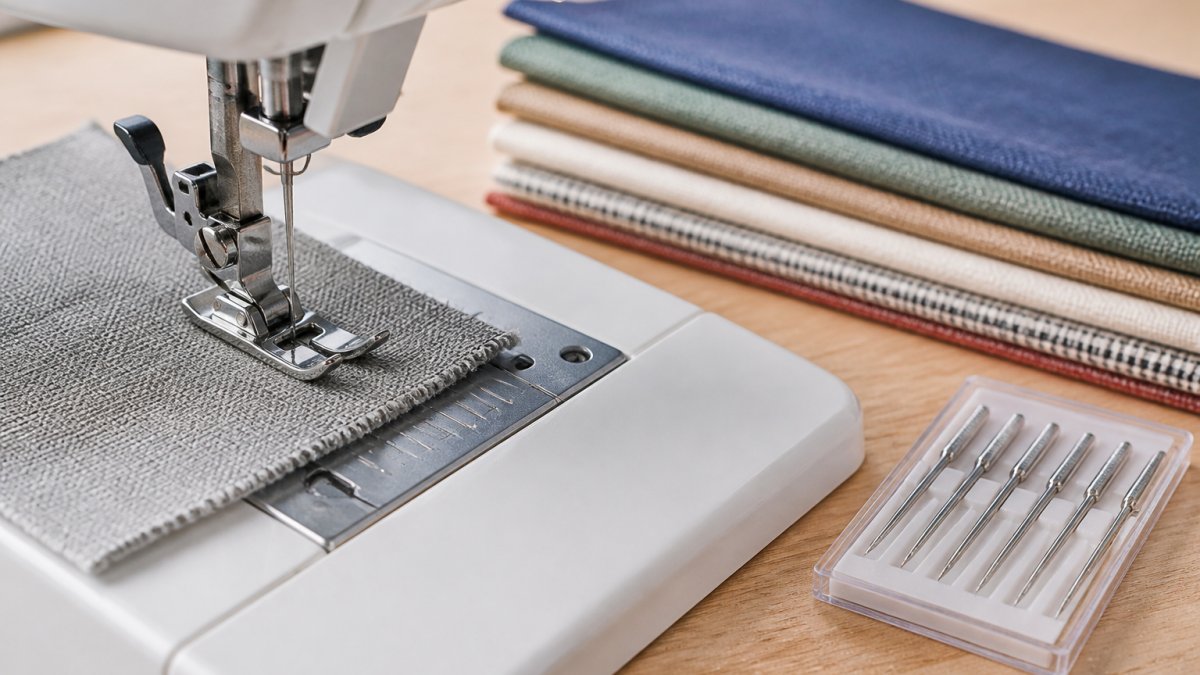
A needle only works if it fits your machine and thread. Three things must line up:
Skipped stitches usually mean the needle is too fine for the thread; shredding means the eye is too small. Change the needle before touching the tension dial.
Before committing to a needle, run a two-minute test on a scrap of the actual project fabric:
If the test fails, change one variable at a time, needle size, then type, then thread, to isolate the cause faster.
Sewing machine needle sizes explained comes down to two numbers separated by a slash: the first is the American size, the second the European size, describing the same needle.
So 80/12 is American 80, European 12; 90/14 is American 90, European 14. The bigger the number, the thicker the needle.
Here's how to read the range:
Shaft, eye, and scarf all scale with size: a larger eye handles thicker thread, and a stronger shaft resists bending in dense fabric.
Needle point shapes decide how the needle meets your fabric. Three main types each suit a different material.
A sharp needle has a pointed tip that pierces woven fabric cleanly, cotton, linen, and other wovens, plus denim and canvas in heavier sizes.
The universal needle that comes in most machines has a slightly rounded point for wovens and some knits, a compromise, not a perfect match for either.
The best needle for knit fabric is a ballpoint sized to the fabric's weight: 80/12 for lighter knits, 90/14 for heavier ones.
Ballpoint needles work because knit fabric is made of loops, not tight woven threads.
Stretch fabrics like spandex and swimwear need a stretch needle, whose deeper scarf helps the bobbin thread catch reliably.
We carry the SINGER Ball Point Machine Needles in size 14/90.

For medium-weight knits and wovens, the HUSQVARNA® VIKING® Universal Needles Size 90/14 100-Pack has a rounded tip and tapered end that slips through the weave with ease.

A common mistake is using a universal needle on every project.
Change your sewing machine needle every 6 to 8 hours of sewing, or whenever you switch to a very different fabric, the guidance printed on our HUSQVARNA® VIKING® needle packs. A dull needle causes skipped stitches, thread breakage, and puckering long before it snaps.
Here's a simple test routine we recommend before every new project:
Run this test every time. It takes two minutes and saves hours of ripping out bad seams.
Most stitch problems trace back to the needle. Before adjusting tension or rethreading, check the needle type and condition. The table below pairs each symptom with its needle cause, mechanism, and fix.
| Problem | Likely Needle Cause | Why It Happens | Fix |
|---|---|---|---|
| Skipped stitches | Wrong type or dull needle | A dull or sharp point fails to form a clean loop for the bobbin hook to catch | Switch to correct type, replace |
| Fabric runs or holes | Sharp needle on knit | The point cuts the knit loops instead of sliding between them | Use ballpoint needle |
| Puckered seams | Needle too large | A thick shaft displaces more fabric than the seam can recover | Drop one size |
| Thread breakage | Needle too fine or bent | The eye is too small for the thread, or a bent shaft pinches it | Size up or replace |
| Thread shredding | Eye too small or burr on eye | Thread rubs against the eye's edges and frays | Size up, or replace if the eye has a burr |
| Bent or broken needle | Needle too fine for fabric | The shaft cannot resist the fabric's density | Use heavier needle |
| Uneven stitch length | Bent needle | A bent shaft changes the stitch formation cycle | Replace needle |
| Fabric snagging on fine wovens | Universal point on delicate sheer | The slightly rounded point catches fine threads | Switch to sharp or Microtex |
| Needle strikes throat plate | Bent needle or wrong system | A bent shaft or wrong system misaligns the needle | Replace with correct system and size |
Not every stitch flaw is a needle problem. Quick check:
Sewers often blame tension for every problem, but needle type and condition cause most skipped stitches and fabric damage. Change the needle first, then adjust tension only if the problem persists.
Different needle mistakes leave different marks:
If you see any of these, stop sewing. Continuing with the wrong needle makes the damage worse and can ruin the project.
For a deeper reference, the Know Your Needles pocket guide by Liz Kettle covers 30 common hand and machine needles, explaining what each does and how needles are sized, a handy companion for anyone learning to match needle to fabric.

The HUSQVARNA® VIKING® Quilting Needles Size 80/12 100-Pack has a tapered tip for easier fabric penetration and helps eliminate skipped stitches on lightweight fabrics, a solid pick for quilt piecing.
The first number (80 or 90) is the European metric size, and the second (12 or 14) is the American size. A 90/14 needle is thicker and works for medium-weight fabrics like denim or canvas. An 80/12 is finer, ideal for lightweight fabrics like silk or cotton voile. Using too large a needle on fine fabric leaves visible holes, while too small a needle on heavy fabric can bend or break.
Use a ballpoint or stretch needle. Ballpoint needles have a rounded tip that slides between knit fibers instead of piercing them, preventing runs and holes. Stretch needles are similar but designed for highly elastic fabrics like swimwear or ribbing. A universal needle can work on stable knits, but ballpoint is the safer choice for jersey, interlock, and other stretchy materials.
Change your needle every 6 to 8 hours of sewing, or sooner if you notice skipped stitches, puckering, or a dull thumping sound. A bent or blunt needle damages fabric and causes thread breakage. If you hit a pin or sew through heavy material, replace the needle immediately. Keeping a fresh needle in your machine is one of the easiest ways to improve stitch quality.
A universal needle in size 80/12 or 90/14 works well for most polyester fabrics. If the polyester is a knit or has stretch, switch to a ballpoint or stretch needle to avoid damaging the fibers. For lightweight polyester lining, use a finer 70/10 or 80/12 needle. Always test on a scrap first to check for puckering or skipped stitches.
Matching needle to fabric is one of those skills that changes everything once it clicks. Stitch Pro Supply is built around our Learn First. Shop Second. approach, so you pick the right tool before you spend a dollar. Our team offers practical education and expert support, plus a curated selection of trusted needles and supplies. We ship fast, and we stand behind what we sell. Get started with Stitch Pro Supply and sew your next project with confidence.


