Your Cart (0)
Your cart is empty
Tax included and shipping calculated at checkout
Drawer menu
Tax included and shipping calculated at checkout

Last Updated: September 11, 2026
Finding the best sewing machine for thick fabrics comes down to one thing: whether the motor can push a needle through multiple layers without stalling. This guide from Stitch Pro Supply breaks down the five SINGER Heavy Duty models we recommend most.
If you sew denim, canvas, leather, or upholstery, a standard machine will fight you: feed dogs slip, needles snap, stitches skip. The machines below use full metal interior frames and motors tuned for piercing power.
| Model | Price | Best For | Standout Feature |
|---|---|---|---|
| SINGER Heavy Duty 4452 | $219.99 | Most sewists | Six presser feet included |
| SINGER Heavy Duty 4552 Next Evolution | $259.99 | Leather and vinyl | Walking foot included |
| SINGER Heavy Duty 6360 | $249.99 | Large projects | Extension table |
| SINGER Heavy Duty 6700C | $329.99 | Computerized control | 586 stitch applications |
| SINGER Heavy Duty 4411 | $189.99 | Budget buyers | Full metal frame |
A heavy-duty sewing machine has a full metal interior frame, a motor rated for continuous piercing power, and enough presser foot clearance for multiple fabric layers. Plastic frames flex under load, which is why budget machines skip stitches on denim.

Two specs decide whether a machine handles thick fabric: motor torque and presser foot lift.
Torque is rotational force, and it determines whether the needle pushes through eight layers of canvas or stalls halfway. Look for "enhanced piercing power" in the spec sheet, which signals a motor tuned for penetration rather than raw speed.
A walking foot moves the top fabric layer in sync with the feed dogs below, so thick stacks feed evenly instead of shifting. On leather, vinyl, and quilted layers, this prevents the top layer from dragging. Standard presser feet rely on feed dogs alone, which works fine on cotton but struggles once layers pile up. The 4552 includes a walking foot; on other models it's a separate purchase. The American Sewing Guild resource library covers foot selection in more depth.
The 4452 is the machine we recommend most often. Six presser feet ship in the box, including a non-stick foot whose slick underside glides over vinyl and leather instead of grabbing.
The motor delivers needle piercing power for denim and canvas, and adjustable presser foot pressure lets you dial back for lightweight sheers. Over 100 stitch applications cover garment work, upcycling, and home decor, plus a top drop-in bobbin and stainless steel bed plate.
Where it falls short: no walking foot included, and the throat space is tighter than the 6700C. For quilting large projects, that matters.
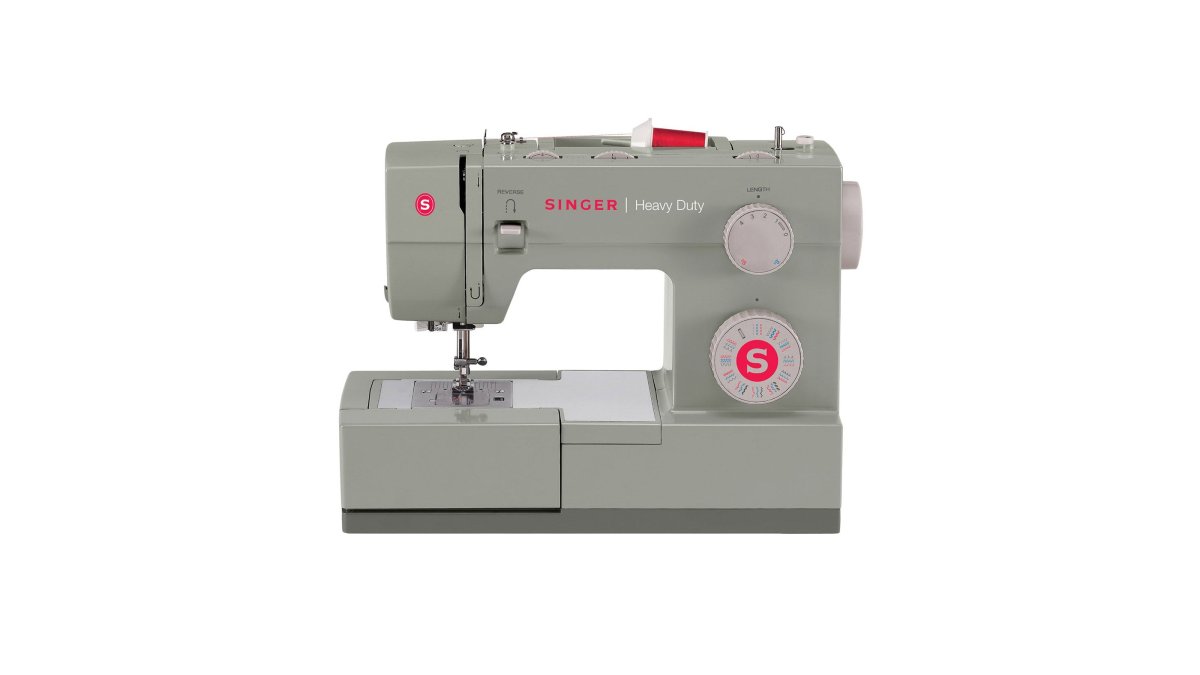
Sewing leather on a home machine usually means fighting the material. The 4552 solves that with an included Even Feed/Walking Foot and Non-Stick Foot, while the full metal interior frame holds stability under load.
Thirty-two built-in stitches cover utility, stretch, and decorative work, and speed control helps on detailed curves where full speed causes skipped stitches. The integrated needle threader and one-step buttonhole are welcome conveniences.
The honest limitation: 32 stitches is fewer than the 4452's 100-plus. If decorative stitching matters, compare before buying.
Large projects need surface area, and the 6360 ships with a slide-on extension table that creates a level sewing surface around the free arm. Quilts, curtains, and costumes stop bunching and dragging.
Throat space is generous, and the motor runs up to 1,100 stitches per minute with enhanced piercing power for multiple layers. Five presser feet are included, along with the non-stick foot for vinyl and leather.
The trade-off is footprint. The extension table takes up real desk space, so measure before committing.
The 6700C offers 586 stitch applications, built-in lettering, and mirror imaging, all selectable by button rather than dial. Its 6.4-inch throat space is the widest in this group.
Adjustable presser foot pressure and a stainless steel bed plate handle the same heavy materials as the mechanical models. The top drop-in bobbin stays visible so you don't run out mid-seam.
What most reviews miss: computerized machines add convenience, not raw piercing power. The 6700C matches the mechanical models on torque, so choose it for stitch variety, not for heavier fabric capability.
The 4411 is the entry point, and it doesn't feel like a compromise. A full metal frame and 69 stitch applications handle denim, leather, and lighter dress-weight fabrics, while the stainless steel bed plate lets fabric glide.
Four essential presser feet come included, plus a top drop-in bobbin and LED lighting. At 1,100 stitches per minute, it keeps pace with machines costing more.
Where it falls short: no walking foot, and fewer accessories than the 4452. If you sew mostly leather, spend the extra.
Sewing machine needles for thick fabric start at size 100/16 and go up to 110/18 for denim and canvas (schmetz.com). A universal 80/14 needle bends or snaps on heavy layers. Match the needle to the fabric, not the machine.
Use a denim needle (100/16 or 110/18) for woven heavy fabric and a leather needle with a cutting point for leather and vinyl. Change needles every project on heavy material; a dull needle causes skipped stitches and puckering.
Thread weight matters too. Heavy-weight thread pairs with a larger needle and slightly looser tension. If stitches loop underneath, raise the needle size before adjusting the bobbin case. The Consumer Product Safety Commission guidance on sewing equipment covers general equipment safety.
You can sew thick fabric on a regular machine if it has a metal frame and enough torque. The technique matters as much as the machine.
A common mistake is forcing fabric through. Let the feed dogs do the work. If the machine stalls, reduce layers or switch to a larger needle.
A heavy duty sewing machine for leather needs three things: a walking foot, a non-stick or roller foot, and piercing power. Leather doesn't compress, so the needle must cut cleanly through rather than push fibers aside.

The 4552 is our top pick for leather because the walking foot and non-stick foot ship in the box; the 4452 handles leather well with its included non-stick foot. For regular leather projects, the 4552's accessories save money over buying them separately.
One caveat: home machines handle garment-weight leather, not saddle-weight hides. For that, you need an industrial machine.
Domestic machines suit most home sewists working with denim, canvas, and garment leather. Industrial machines deliver continuous torque and higher duty cycles but cost more and need dedicated space.
The practical difference comes down to volume. If you sew a few heavy projects a month, a domestic heavy-duty machine like the 4411 or 4452 covers it; if you sew daily for production, an industrial machine earns its price.
That's the standard answer, and it's incomplete. The real dividing line isn't how often you sew, it's duty cycle, and almost no buying guide explains it.
Duty cycle is the ratio of run time to rest time a motor can sustain without overheating. A domestic heavy-duty motor is typically rated for intermittent duty: a few minutes of continuous sewing, then a cooldown. Industrial motors are rated for continuous duty, running for hours without a rest cycle. The difference is physical, motor housing, cooling fan, and thermal mass of the windings.
In practice, a domestic heavy-duty machine sewing denim at moderate speed feels warm at the motor housing after roughly 15 to 20 minutes of continuous work. That warmth is the signal to stop; keep going and you risk scorching the windings, the most common way home machines die on heavy fabric. An industrial machine runs cool indefinitely.
Ask yourself one question: do you ever sew for more than 20 minutes without stopping? If no, you sew a seam, press it, pin the next piece, a domestic heavy-duty machine is fine, since natural pauses are cooldown periods in disguise. If yes, bag-making, quilting a large piece, or production batches, you'll hit the thermal limit regularly, and an industrial machine is the honest answer.
Domestic heavy-duty machines cool their motors passively through vents in the housing; industrial machines use active cooling, a fan driven by the motor shaft, pushing air across the windings continuously. That's why an industrial machine can be smaller than you'd expect and still run all day, and why you should never block the vents on a domestic machine. Ambient temperature matters more than most owners realize.
You don't have to jump straight to an industrial machine. A few practices extend a domestic machine's effective duty cycle:
Three signals mean a domestic machine, even a heavy-duty one, is the wrong tool:
For everyone else, the home sewist making jeans, hemming denim, upholstering a chair, or sewing canvas bags on weekends, a domestic heavy-duty machine in this category is the right call. Respect the duty cycle and it will outlast your projects.
The best sewing machine for thick fabrics depends on your projects and budget. The SINGER Heavy Duty 4452 at $219.99 offers a strong motor, adjustable presser foot pressure, and six presser feet including a non-stick foot for vinyl and leather. For larger quilts or home decor, the SINGER Heavy Duty 6360 at $249.99 adds an extension table and extra high presser foot lift. Both handle denim, canvas, and multiple layers without skipped stitches.
A regular machine can sew thick fabric if you adjust needle size, thread tension, and presser foot pressure. Use a heavy-weight needle (size 100/16 or 110/18), a longer stitch length, and slow the sewing speed. However, lightweight motors may stall on multiple denim layers. A heavy duty sewing machine for leather or denim projects, like the SINGER Heavy Duty 4411 at $189.99, has the motor torque and metal frame to handle thick materials consistently.
Set your stitch length to 3.0-4.0 mm for thick fabrics, increase thread tension slightly, and reduce presser foot pressure if the fabric bunches. Use a walking foot or even feed foot to keep layers moving together. For denim and canvas, a size 100/16 needle and heavy-weight thread work best. Test on a scrap piece first, since every machine and fabric combination behaves differently.
The SINGER Heavy Duty 4552 Next Evolution at $259.99 includes a walking foot and non-stick foot, making it a strong choice for leather and vinyl. Its full metal interior frame and strong piercing power handle thick hides without skipped stitches. Pair it with a leather needle (size 110/18) and heavy-weight thread. For lighter leather work, the SINGER Heavy Duty 4452 at $219.99 also includes a non-stick foot and handles vinyl and leather well.
Look for a full metal frame for stability, high motor torque for needle penetration through multiple layers, adjustable presser foot pressure, and an extra high presser foot lift for clearance. A walking foot helps feed thick layers evenly. Stainless steel bedplates reduce friction on denim and canvas. Also check stitch length range and needle compatibility. Machines like the SINGER Heavy Duty 6700C at $329.99 offer computerized stitch selection plus these heavy duty features.
Sewing thick fabric shouldn't mean fighting your machine every seam. At Stitch Pro Supply, we built our catalog around education first, so you choose the right tool instead of guessing. Our team can walk you through motor specs, presser foot options, and needle selection before you buy, and every machine ships fast with secure checkout. Get started with Stitch Pro Supply and pick the heavy-duty machine that matches your projects.
