Your Cart (0)
Your cart is empty
Tax included and shipping calculated at checkout
Drawer menu
Tax included and shipping calculated at checkout

Last Updated: September 22, 2026
Premium embroidery machines differ from entry-level models in three measurable ways: stitch consistency, component durability, and the size of the embroidery field they can handle. Those differences decide whether a machine survives daily production or stalls out after a few months of steady use.
Two engineering details separate the tiers:
Stitch density is the number of stitches packed into a given area, and it's the single biggest driver of whether embroidery looks professional or homemade. Premium machines let you adjust density in fine increments, which matters when you're working with different stabilizers and fabric weights. Entry-level models often lock you into preset densities that work on cotton and fail everywhere else.
Metal frames, sealed bearings, and a metal bobbin system are the tell. Run your hand along the arm of a budget machine and a premium one back to back and you'll feel the difference in weight and rigidity. That mass isn't marketing; it's what keeps thread tension stable through a long production run.
Throughput is where premium embroidery machines pay for themselves, and the reason is mechanical, not marketing. On a commercial run, the clock is not spent stitching, it is spent in the gaps between stitches. Automatic thread trimming, sequenced color changes, and multi-needle heads exist to collapse those gaps, and gap time is what kills a commercial shop's margins.
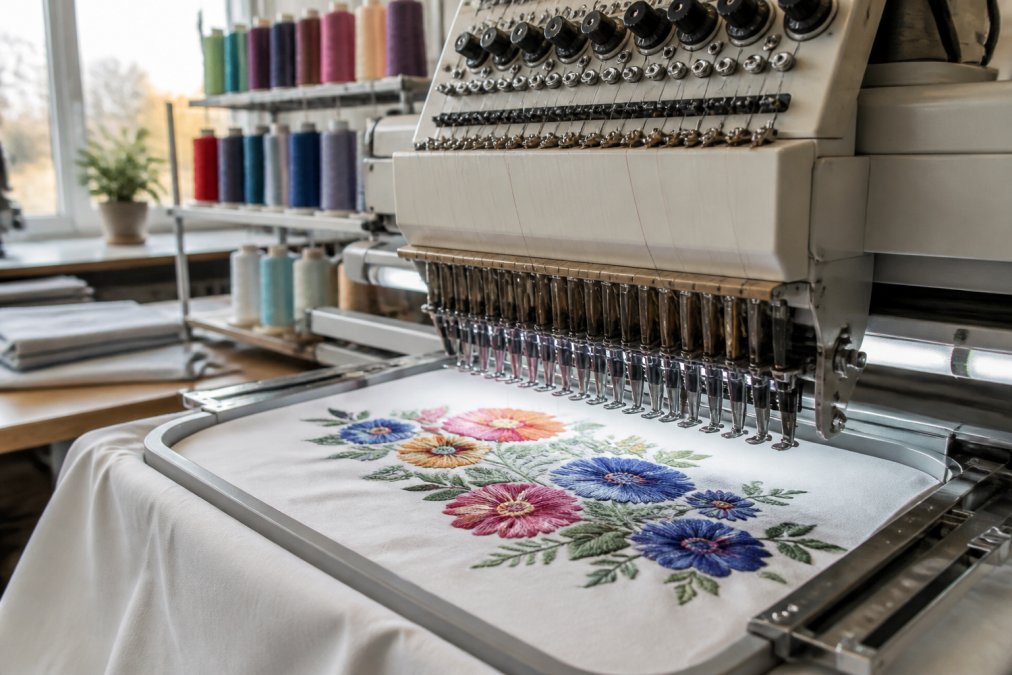
A typical embroidered logo on a polo shirt might carry 6,000 to 8,000 stitches and three to five thread colors. On a single-needle machine, every color change is a manual sequence: stop the machine, trim the top thread, pull the bobbin thread, rethread the needle, advance to the next color block, and re-register the hoop so the new color lands in the right place.
Run the numbers on your own workflow before you buy. Set a stopwatch through a five-color design on your current machine and record the total elapsed time from start to finished garment. Then subtract the pure stitching time your machine's spec sheet reports. The remainder is your changeover overhead.
Throughput gains do not stop at color changes. Three other mechanisms matter at volume:
The math cuts the other way for low-volume work. If you finish fewer than a handful of multi-color items per week, the changeover overhead is small in absolute terms, and a multi-needle machine's higher purchase price and larger footprint will not earn back. The upgrade is a volume decision, not a quality decision, a well-tuned single-needle machine produces the same stitch quality on a one-off gift.
Single-needle machines suit hobbyists and low-volume custom work; multi-needle machines suit shops producing repeat designs at volume. The right pick depends on your order mix, not on which machine is "better."
| Machine Type | Best For | Color Changes | Typical Use |
|---|---|---|---|
| Single-needle | Hobbyists, one-off gifts | Manual | Personal projects, samples |
| Multi-needle | Shops, Etsy sellers | Automatic | Repeat orders, batches |
If you're embroidering names on gifts, testing designs, or running fewer than a handful of items per week, a single-needle machine is the smarter buy. The HUSQVARNA® VIKING® DESIGNER QUARTZ™ 29 handles both sewing and embroidery, includes 180 built-in designs and two hoops, and its 7-inch touchscreen makes design scaling and combining straightforward. For a beginner who wants one machine that does everything, it's a strong starting point.

Once color changes eat more than a few minutes per item, multi-needle pays off. The math is simple: fewer stops means more finished pieces per day, and more pieces per day means better turnaround time for customers. If you're running an Etsy shop with steady embroidery orders, this is usually the upgrade that changes your week.
The embroidery machine features to look for come down to four things: software compatibility, hoop sizes, connectivity, and the user interface. Get those right and the machine will still fit your workflow two years from now.
Check how designs get onto the machine before anything else. USB connectivity is the baseline; Wi-Fi integration and cloud platforms are the upgrade. The SINGER® SE9180 pairs a 7-inch touchscreen with CREATIVATE™ connectivity, letting you send designs wirelessly and track embroidery progress from an app. That matters if you digitize custom designs regularly.
Embroidery machine maintenance tips worth following are boring and effective: clean the bobbin area, change needles on schedule, and keep the machine covered. Skipping them is how a machine that should last years starts missing stitches in months.
Long-term ROI on premium embroidery machines comes from three places most buyers overlook: lower maintenance costs, e-commerce workflow integration, and energy use per finished piece. A machine that runs cooler and needs fewer repairs costs less every month it operates. This is the section competitors skip, and it is where the real purchase decision lives.
Sticker price is the smallest number in the equation. A total cost of ownership (TCO) analysis for an embroidery machine has five recurring line items, and premium machines tend to win on four of them:
E-commerce integration is the angle competitors skip entirely, and it is where premium machines create leverage for small sellers. If you sell on Etsy or your own storefront, cloud-connected machines let you move from order to design to stitch without juggling flash drives or re-typing file names.
Energy efficiency matters more as volume grows, and the mechanism is straightforward. Industrial-strength components run more efficiently under load than budget motors straining at their limit. A motor operating near its maximum rated capacity draws more current and generates more heat than the same motor operating in its comfortable range, and heat is the enemy of every bearing, belt, and circuit board in the machine.
It depends on how often you stitch and what you plan to make. Premium embroidery machines offer faster color changes, larger embroidery fields, and better stitch quality, which matter most if you sell items or complete complex designs regularly. If you stitch occasionally for gifts, a mid-range model like the SINGER SE9180 at $799.99 may cover your needs. The key is matching machine capability to your actual production volume, not buying for hypothetical future use.
Premium embroidery machines typically include larger embroidery fields, multi-needle capability for faster color changes, automatic thread trimming, higher stitch density control, and advanced software compatibility for importing custom designs. They also tend to have touchscreen controls, Wi-Fi integration, and more durable components built for commercial production. Entry-level machines often cap out at smaller hoop sizes and require manual thread changes, which slows turnaround time on multi-color designs.
Better stitch quality comes from tighter manufacturing tolerances, more precise thread tension control, and consistent fabric feeding. Premium machines often include sensor systems that adjust to fabric thickness automatically, reducing puckering and misalignment. They also handle a wider range of stabilizers and fabric types without constant re-tensioning. The result is cleaner, more consistent stitching across long production runs, which matters if you sell finished pieces where errors cost money.
High-end embroidery machines use more durable components, which means fewer breakdowns and longer service intervals. Many premium models include self-diagnostic features and automatic oiling systems that reduce manual upkeep. Parts availability and technical support are also better for professional-grade machines, so repairs happen faster when something does go wrong. Following basic embroidery machine maintenance tips, like regular cleaning and tension checks, extends the lifespan further and protects your investment.
The hard part isn't choosing a machine. It's choosing one that still fits your workflow after the first hundred orders, when a cheap machine's limits start showing. At Stitch Pro Supply, our Learn First. Shop Second. philosophy means we walk you through hoop sizes, software compatibility, and production needs before you spend a dollar, backed by carefully selected machines and fast U.S. shipping. Get started with Stitch Pro Supply and pick a machine you won't outgrow in six months.


