Your Cart (0)
Your cart is empty
Tax included and shipping calculated at checkout
Drawer menu
Tax included and shipping calculated at checkout

Quick Summary

The 5 best sewing machines for garment construction are the SINGER Heavy Duty 6600C Sterling, HUSQVARNA VIKING EMERALD 118, SINGER Heavy Duty 4452, SINGER Quantum Stylist 9960 and HUSQVARNA VIKING ONYX 25. Each was selected from the Stitch Pro Supply catalog for handling multiple layers, stretch knits and durable seams across different budgets and skill levels.
Last Updated: October 30, 2026
Choosing a sewing machine for garment construction is different from picking one for quilting or crafts, and the 5 best sewing machines for garment construction in this guide were picked with that difference in mind. Garments ask a machine to sew through multiple layers, handle stretch knits and dense denim, and produce seams that hold up to wear. At Stitch Pro Supply, we narrowed our focus to five machines from our own catalog that fit these demands across different budgets and skill levels.
Our selection started with one question: which machines handle the work of making clothes, not just decorative stitching? We looked at motor strength, throat space, presser foot pressure, and the stitch options that matter for seams, hems, and buttonholes. We also considered who each machine suits best, from first-time garment sewists to experienced makers who want a workhorse.
Every machine on this list comes from the Stitch Pro Supply catalog, and we describe only the features listed on each product page. Where a machine excels at one task, we say so, and we note the tradeoffs that could matter to your sewing.
Most sewing-machine roundups list the same features for quilting, crafts, and garments, so the features below focus on what matters when comparing the 5 best sewing machines for garment construction. Garment construction is different: you are sewing curved seams on sleeves and necklines, joining multiple layers at a waistband, and finishing edges that will be washed and worn. The features below are the ones that actually change how a machine behaves on apparel, and the ones we weighted most heavily when narrowing the five machines in this guide.
Adjustable presser-foot pressure. Presser-foot pressure controls how hard the foot presses fabric against the feed dogs, and adjustable pressure lets one machine handle both very lightweight sheers and heavier fabrics.
A free arm. A free arm is the narrow, removable section of the bed that exposes a slim cylinder under the needle. It is what lets you sew a finished pant leg, a sleeve cuff, or a narrow hem without fighting the fabric around the machine's body.
Stretch stitches and a stretch-stitch menu. Knits need a stitch that stretches with the fabric. Look for a built-in zigzag plus at least one true stretch stitch, a three-step zigzag or a lightning/elastic stitch, and confirm the machine lists them as knit-appropriate rather than only decorative.
One-step buttonholes (and more than one style). Buttonholes are the garment task most likely to ruin a project. A one-step, automatic buttonhole is the baseline; better machines add a second style (keyhole or rounded) and a buttonhole foot with a slider that holds the button for sizing.
Needle up/down and needle positioning. Needle up/down lets you stop with the needle in the fabric so you can pivot at a corner without the seam shifting. Adjustable needle positions (left, center, right) matter for edge-stitching collars, topstitching pockets, and keeping a consistent seam allowance. These are small conveniences individually, but they compound across a full garment.
Throat space and harp width. The throat, the gap between the needle and the machine's upright arm, determines how much fabric you can bunch up while sewing. A wider throat helps when you are maneuvering a gathered skirt or a quilted jacket, but for most garment seams a standard throat is workable.
Feed dogs that can drop. Dropping the feed dogs lets you free-motion sew or darn, and it also helps with certain decorative techniques. It is not essential for basic garment construction, but it is a useful signal that the machine is built for more than straight seams.
Compatible presser feet. The feet included in the box tell you what the manufacturer expects you to do. For garments, look for a standard zigzag foot, a buttonhole foot, a zipper foot, and ideally a blind-hem foot and an overcasting foot. A walking foot, sometimes included, sometimes sold separately, is the upgrade that most improves handling of knits, vinyl, and multiple layers.
For garment construction, the distinction matters in more specific ways: it affects how consistently you can reproduce a seam across a size run, how easily you can switch between a knit and a woven, and what happens when the machine needs service.
How the two types actually differ at the needle. A mechanical machine sets stitch length, width, and pattern with physical dials and a cam or lever system. What you set is what you get, and the settings stay put until you move them. A computerized machine stores stitch settings in memory and selects them with a panel; it can also automate sequences, a one-step buttonhole that measures the button, a needle that stops in the down position, a thread trimmer, or a mirror-image stitch. The mechanical advantage of computerized control is repeatability: the same buttonhole comes out the same length on the tenth shirt as on the first.
Where mechanical machines win for garments. Mechanical machines are simpler, generally cheaper to buy, and easier for a local technician to repair because there are fewer electronic components to diagnose. If you sew mostly wovens, cotton shirts, linen dresses, denim, and you are comfortable setting dials by feel, a mechanical machine with a strong motor and adjustable presser-foot pressure covers nearly all garment work.
Where computerized machines win for garments. Computerized machines earn their price on tasks that require consistency and fine control: buttonholes on shirts and dresses, stretch stitches on knits, decorative topstitching, and switching between fabric types without re-dialing every setting. Needle up/down, speed limiting, and stitch memory reduce fatigue on long projects. If you sew garments frequently or sell them, the repeatability is a real production advantage, not a luxury.
Reliability and repair.
Controls and learning curve. Mechanical dials are intuitive and teach you what each setting does because you feel the change. Computerized panels can be faster once learned but add menus and modes that beginners sometimes find distracting. For a first garment machine, a mechanical model with clearly labeled dials is often the easier path; for a sewist who already knows what settings they want, computerized control saves time.
Maintenance. Both types need regular lint removal, oiling where the manual specifies it, and periodic servicing. Computerized machines are more sensitive to dust and to power surges, so a surge protector is a sensible add-on. Mechanical machines tolerate a wider range of home conditions but still benefit from the same cleaning routine.
SINGER® Quantum Stylist™ 9960 Sewing Machine with Extension Table →
A practical middle path. If you are unsure, buy for the features you will use in your next five garments rather than for the maximum stitch count.
| Machine | Starting Price | Type | Best For |
|---|---|---|---|
| SINGER Heavy Duty 6600C Sterling | $269.99 | Computerized | Denim and canvas |
| HUSQVARNA VIKING EMERALD 118 | $619.00 | Computerized | Versatile everyday garments |
| SINGER Heavy Duty 4452 | $249.99 | Mechanical | Budget workhorse for beginners |
| SINGER Quantum Stylist 9960 | $549.99 | Computerized | Design-focused garment makers |
| HUSQVARNA VIKING ONYX 25 | $399.00 | Mechanical | Growing skills on a budget |
If your garments involve denim jeans, canvas jackets, or other heavy fabrics, the Heavy Duty 6600C Sterling is built for that work. Its powerful motor provides extra sewing speed, and its 6.4-inch (163 mm) throat space gives you room to work with the machine.
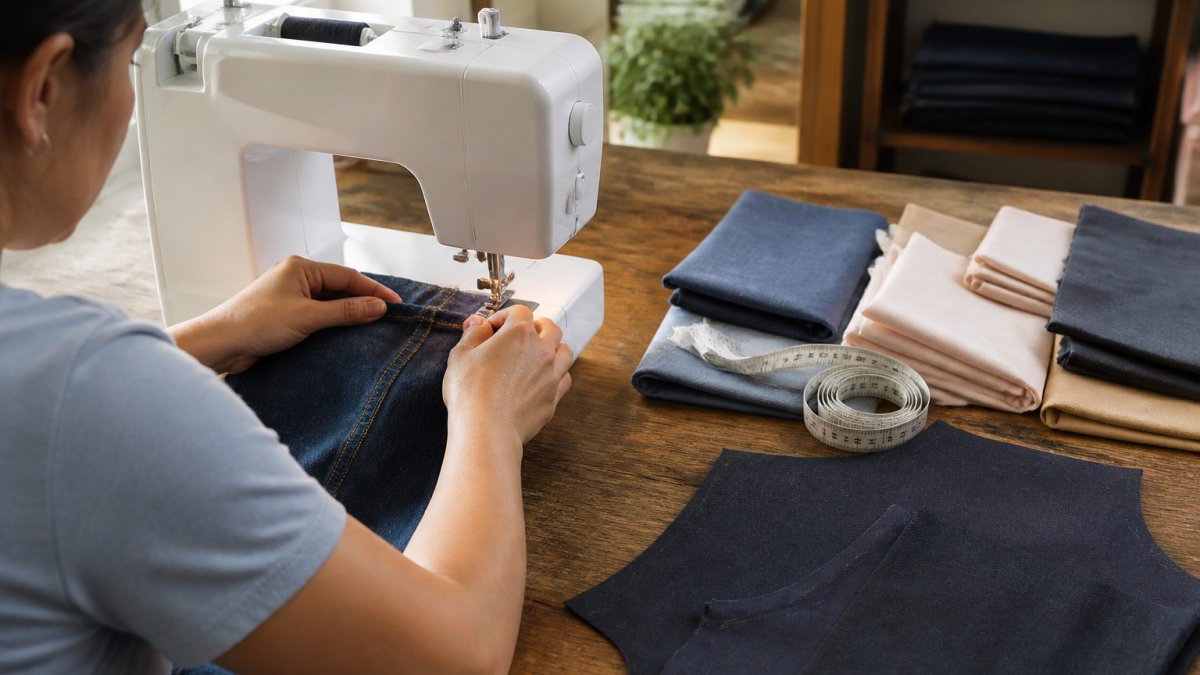
Adjustable presser foot pressure also means the same machine can sew very lightweight sheers. The stainless steel bedplate lets fabric glide, and the one-step buttonhole produces consistent results across projects.
Best for: sewists who regularly construct jeans, jackets, and other heavy garments.
Skip if: you mostly sew lightweight knits and want a machine with a wider range of decorative stitches.
The EMERALD 118 suits many garment projects. It includes utility, decorative, and stretch stitches along with a one-step buttonhole, and its adjustable stitch length and width let you tailor each seam.
A built-in needle threader and a Sewing Guide Reference Chart help you choose the right presser foot, stitch settings, and thread tension for different fabrics.
Best for: sewists who alternate between many fabric types and want guidance built into the machine.
Skip if: your budget is tight, since this is the most expensive machine on our list.
The Heavy Duty 4452 gives beginners a dependable starting point for garment construction. It runs at up to 1,100 stitches per minute and offers 32 built-in stitches, including 7 stretch stitches and a fully automatic one-step buttonhole.

Automatic needle threading and a top drop-in bobbin with a clear cover simplify setup. The included walking foot and non-stick foot are included with this machine.
Best for: beginners who want a sturdy machine without a large investment.
Skip if: you want computerized stitch programming or a long list of decorative options.
The Quantum Stylist 9960 lets makers add custom touches to their projects. It offers 1,172 stitch applications and five fonts, and you can mix stitches and lettering to build unique sequences. Many stitches can be mirror-imaged and elongated.

The Needle Up/Down function allows pivoting during sewing, and the Speed Control lets you set the maximum sewing speed. A thread trimmer button cuts both top and bottom threads.
Best for: garment makers who value decorative detail and creative stitch options.
Skip if: you mainly need straightforward seams and do not plan to use decorative features.
For garment construction, look for a strong motor that handles multiple fabric layers, adjustable presser foot pressure for light and heavy fabrics, a reliable one-step buttonhole, and a range of utility and stretch stitches. A top drop-in bobbin makes threading faster, and a stainless steel bedplate helps fabric glide during long seams. Speed control is useful when you move between delicate seams and bulky hems.
Not necessarily. Machines such as the SINGER Heavy Duty 6600C Sterling and the SINGER Heavy Duty 6700C are designed with heavy duty projects, from denim to canvas, in mind. Industrial machines offer higher speeds and more power for production sewing, but
Mechanical machines use dials to select stitches and are simpler to repair and often less expensive. Computerized machines, such as the SINGER Heavy Duty 6700C with 586 stitch applications, use a control panel to select stitches, and they usually offer built-in lettering, mirror imaging and one-step buttonholes.
Prices in our catalog start at $189.99 for the SINGER Fashion Mate 3342 and go up to $619.00 for the HUSQVARNA VIKING EMERALD 118. Heavy-duty models such as the SINGER Heavy Duty 4452 and 64S start at $249.99. Choose based on how often you sew, the fabrics you use, and whether you need features like a larger throat space or extension table.


